I friend dropped in yesterday and mentioned something I thought may be of interest. David being an aircraft nut mentioned a chap in the states that had added a mod to an aircraft exhaust sysyem which had added to the engines power output, exact figure i do not have. Esentially in the exhaust just after the head, a cone is inserted into the individual pipes which narrows in direction away from the head (exact dimensions I do not have) This sets up a pressure wall which prevents a back flow of gasses towards the cylinder and so helps the next combustion cycle? . There ends what I know. Any ideas anyone?

You are using an out of date browser. It may not display this or other websites correctly.
You should upgrade or use an alternative browser.
You should upgrade or use an alternative browser.
Exhaust query?
- Thread starter MartinGough
- Start date
Called AR cones ( Anti Reversion ). Does exactly what you have stated. Quite useful as crutch to build a smoother idle and pick up a bit of low rpm tractability in a car which would otherwise be very 'cammy' at those low rpm. As it helps prevent reversion during the o/lap period it would be very helpful in the Weber IDA situation. Dyno tests I have read on what was a full house Nascar ( unrestricted) engine showed that the AR headers allowed the engine to accept full throttle approx 1500 rpm lower than the original exhaust headers.
Have built several sets for many different applications with benefits as above with no apparent top end penalty.
Works on the principal that reversion gasses tend to flow back along the runner wall while high speed gas flows in the main stream at center or thereabouts.
Jac Mac
Have built several sets for many different applications with benefits as above with no apparent top end penalty.
Works on the principal that reversion gasses tend to flow back along the runner wall while high speed gas flows in the main stream at center or thereabouts.
Jac Mac
Sounds like a tuned pipe which is used to reflect pressure waves back into the cylinder, effectively compressing the charge. This, however, is usually used in a 2-cycle engine.

I read on some motorcycle forum that it is to do with reflected waves, I think that it is too short to be a tuned pipe. It is a simple venturi, so what I think it does, is, at the penalty of a small back pressure it increases the flow velocity in the neck of the venturi. This additional kinetic energy gives more resistance to reversion i.e backflow as it is able to overcome small negative pressure waves at low rpm. At high rpm, provided the venturi is not too restrictive, it will have little or no effect.
Cheers guys. Might have a play with this one.
jac mac said:Dyno tests I have read on what was a full house Nascar ( unrestricted) engine showed that the AR headers allowed the engine to accept full throttle approx 1500 rpm lower than the original exhaust headers.
Jac Mac
Jac Mac,
So would this be a benefit in the normal racing rev range, or does it occur way below that? If it's at the lower (unused) end, what's the point of it in a Nascar or similar engine?
If you want to smooth out a cammy road engine it'd be cheaper and easier just to change the cam than build a new set of headers. As many guys have stated here before, you can build a very nice mild engine that will have more than enough power for a road going GT40.
Interesting concept though. What applications did you build your headers for?
Cheers
Russ Noble said:Jac Mac,
So would this be a benefit in the normal racing rev range, or does it occur way below that? If it's at the lower (unused) end, what's the point of it in a Nascar or similar engine?
If you want to smooth out a cammy road engine it'd be cheaper and easier just to change the cam than build a new set of headers. As many guys have stated here before, you can build a very nice mild engine that will have more than enough power for a road going GT40.
Interesting concept though. What applications did you build your headers for?
Cheers
Russ,
In the case of that Nascar engine it did not hurt the power figures in the mid/top end ranges. This dyno test was back in the late 80's ( this is not 'new' tech- aviation can be painfully slow to adopt new tech, they have to chop down a couple of forests first to creat the paperwork that will allow the aircraft part/mod in question to fly) when exhausts on typical chev/ford 355 primary pipes were 17/8" dia. Where it showed big benifits was on shorter tracks where the rpm differential was larger. As time went on we saw the introduction of smaller primary pipes & then stepped primarys 1.625-1.75-1.875 which perform a similar function @ each of the steps to a lesser degree.
In the GT40/Road car scenario- yes to use a milder cam would make sense, but these exhaust mods would allow the 'new' cam to be even more tractable. In some Holley equipped situations, power valve problems disappeared after Ar type headers were fitted. In your own situation I would think that it would be a huge benefit particularly in the long distance ( 3hr ) events where if you can get thru a corner in 3rd rather than 2nd will see you a much fresher budgie at the end of the race along with less wear & tear on the car.
I've built them for just about every type of motorsport I have been involved with. HQ Holden, Osca/Trans Am, 2litre Hydroplanes, 240ci Heavyweight Stock cars, Production saloons. Dont touch Hair Dryers so dont know if there is any benefit there. JO's car has stepped primaries, no cones due to space restrictions.
Jac Mac
If the pipe/headers lets say are 1 7/8th of an inch what sort of cone size would be used, how long would it be and is there an optimum position down the pipe.
MartinGough said:If the pipe/headers lets say are 1 7/8th of an inch what sort of cone size would be used, how long would it be and is there an optimum position down the pipe.
Martin,
The ideal situation is if you can continue the cross sectional shape & area of the exhaust port into the primary pipe for approx 1". If your ex port had the same area as the id of a 1.625" tube then your 1.875" primary would fit over the 'cone'. If this is not possible then you can expand the start of the 1.875" primary out to 2" or 2.125" where it goes over the 'cone' to create the same effect. The 'cone' does not have to be at the head/exhaust flange and can be fabricated at a more suitable point in the primary pipe for space reasons. As to the ID of the cone it should not be any smaller than the port id or area.
The extra stud bosses or holes on many aftermarket cyl heads are to allow larger primary pipes or the construction of this type of system. BIG does not necessarily mean better in this instance!
Jac Mac
Jac
Many thanks for the detailed info. Plenty to think about.
Regards Martin.
Many thanks for the detailed info. Plenty to think about.
Regards Martin.
You started a good thread here Martin, but what is there to think about? It's a no brainer.
Good timing though, my heads will arrive in a few weeks and I'll be making a start on my headers. Obviously they will now be AR.
Thanks again Jac Mac. Any more good ideas?
Cheers
Good timing though, my heads will arrive in a few weeks and I'll be making a start on my headers. Obviously they will now be AR.
Thanks again Jac Mac. Any more good ideas?
Cheers
Russ please keep us informed as to how you get on.
Martin.
Martin.
looks like there's different degrees of taper
these look like they go right at the flange
(they are from biker apps)

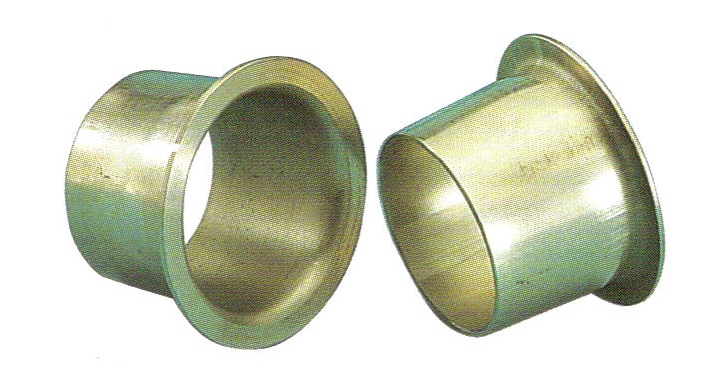
these look like they go right at the flange
(they are from biker apps)
Russ Noble said:You started a good thread here Martin, but what is there to think about? It's a no brainer.
Good timing though, my heads will arrive in a few weeks and I'll be making a start on my headers. Obviously they will now be AR.
Thanks again Jac Mac. Any more good ideas?
Cheers
Yes, make sure you have your tuned length of tailpipe ( approx 35"-40" depending on engine size/valve timing ) before any muffler/silencer function takes place!!!! It can be done.
That should keep the thread active for a bit.
Jac Mac
jac mac said:Works on the principal that reversion gasses tend to flow back along the runner wall while high speed gas flows in the main stream at center or thereabouts.
Jac Mac
Now can you enlighten me on this one. Reversion pulses in the exaust pipe. Ok. What is creating the reversion? I am assuming this reversion is coming back up the exaust pipe towards the valve? So the cone would be placed with the smaller ID facing the muffler?
From what I know of reversion pulses on the intake, the reversion is created by the intake valve closing, interrupting the incoming charge. The 'pulse' is from the air on top of the intake valve being pushed backwards, in effect stopping momentarily the intake charge.
So if there is a reversion pulse on the exaust side, would the closing of the exaust valve not halt the escaping gasses ( or slow them down as they stretch)? Does this then mean the reversion is created by the 'opening' of the exaust valve, in theory creating a vacuum against the previous escaping exaust gas? If that were the case, the AR cone would be placed with the smaller end facing the muffler. But the pulse created by the closing of the valve would mean the reversion would be heading towards the muffler, indicating the AR cone smaller ID to face the valve?
Perhaps a venturi at the collector end would be just as efficent?
I think that the gasses running in the middle of the flow continue down the pipe but gasses against the wall will try and run backwards thats why the taper is so minimal? Something like the boundry layer on an aircraft wing.
Someone correct me if I'm wrong but I believe exhaust reversion is created by restriction after the header tubes, backpressure, like the typical muffler or cat conv.RamboLambo said:Now can you enlighten me on this one. Reversion pulses in the exaust pipe. Ok. What is creating the reversion?
Following Smokey (God) Yunick's advice I always built my primary headers oversized by approx 1/4" at the bottom of the exhaust port. This created a "step down" for the exhaust gases which had a tendency to "reverse" at this point and try to flow back into the port. The "step" stopped this reversion and made better power as evidenced on a dyno comparing 2 different styles of primary at the manifold.
As to why this phenomena occurred I wasn't really interested - Smokey said it happened and this was the way to prevent it, and he da man! rockonsmile
As to why this phenomena occurred I wasn't really interested - Smokey said it happened and this was the way to prevent it, and he da man! rockonsmile
Kalun_D said:Someone correct me if I'm wrong but I believe exhaust reversion is created by restriction after the header tubes, backpressure, like the typical muffler or cat conv.
While these restrictions can cause or contribute to reversion its not that simple. Every positive pressure pulse will have a reverse pulse or 'backwave' . When you work out your 'tuned' length it is normal to decide on an rpm that you want your power to be useful at. IE the lower end of your rpm band, fortunately this length will be longer than if you worked it out for the top end of your rpm band. Longer lengths cause less problems than short.You have to compute the length before you can compute the dia.
There would be an advantage in having the primary pipes protude into the collector,s in a similar manner to that of these 'cones'.
With reference to the tailpipe, while in the 'good ol days' it ended ,period, you can create a similar effect by having it end within a large chamber( expansion box ) . In the GT40 example this would involve fabricating your muffler to enclose the tuned length tailpipe, expansion box, and muffler. On a normal 'front engine' you just fit an expansion box at the tuned length point. The length from there on is not critical other than make sure that the exhaust exit is placed in a low pressure area.
Back to Keiths example ,that system worked on the chev where the primary pipes all pointed down leaving the high activity area in the ex port roof area. In the GT40 situation where the primary pipes turn either up or rearwards I would imagine the full circle cones will be more effective.
Jac Mac
Lynn Larsen
Lynn Larsen
Sometimes, visual aids help: see photo of jet exhaust below. In the exhaust pipe the pressures are not linear from center line to pipe wall, nor are they linear along longitudinal length. As seen in the photo, the pressure profile forms sinusoidal (3 dimensional) waves. Now as to the "tuned length" that JM talks about, if the pipe ends at precisely a high pressure node (lighter colored areas) the total flow will be much greater than if the pipe ended at a lower pressure node (actually this, I believe is caused by reversion imparting back pressure, but I am getting ahead of myself.) So the length that would put the pipe on a high pressure node (given the sinusoidal characteristics of the most desired "sweet spot" for the engine in question) would be the "tuned length". As an aside, exhaust diameter is a function of the amplitude of this pressure wave and this becomes important when deciding the diameter of the outlet of the cone. Also, as in all things, the actual dimensions we are talking about, despite the characteristic involved, are trade offs since the wave characteristics change with head/valve/port dimensions, rpm, engine loading and a whole host of conditions. This can be seen in the shrinking size of the pressure nodes as the exhaust exits from the engine, which brings us to the discussion at hand.
Reversion occurs when the pressure node amplitude falls below our compromise pipe diameter and the exhaust gasses leak behind the high pressure nodes along the pipe wall to fill the increasing low pressure areas between pressure pulses. Nearer and in the head, this is enhanced by actual pull back of the piston during that brief period when the exhaust valve is somewhat open ATDC. So that, if a cone is placed inside the pipe that has minimal effect (there will be some) on the high pressure node wave while at the "sweet spot", but closely matches the amplitude during off power periods, it will serve to trap the gasses trying to leak backwards around the high pressure node, in other words, reversion.
Hope this helps.
Reversion occurs when the pressure node amplitude falls below our compromise pipe diameter and the exhaust gasses leak behind the high pressure nodes along the pipe wall to fill the increasing low pressure areas between pressure pulses. Nearer and in the head, this is enhanced by actual pull back of the piston during that brief period when the exhaust valve is somewhat open ATDC. So that, if a cone is placed inside the pipe that has minimal effect (there will be some) on the high pressure node wave while at the "sweet spot", but closely matches the amplitude during off power periods, it will serve to trap the gasses trying to leak backwards around the high pressure node, in other words, reversion.
Hope this helps.
Attachments

Similar threads


- Replies
- 0
- Views
- 1K
- Replies
- 26
- Views
- 8K
- Replies
- 7
- Views
- 6K