GT40s.com
MK-I  MK-II  MK-III  MK-IV  GULF  MIRAGE  J-CAR  LOLA
GT40s.com
Home Forum Gallery Member Rides Support GT40s.com  
Register FAQ Members List Advertisers Search Today's Posts Mark Forums Read

Go Back   GT40s.com > GT40 Technical Forums > GT40 Build Logs

Notices

GT40 Build Logs For build threads and build diaries only.

Reply
 
LinkBack Thread Tools Display Modes
Old 10-08-07, 11:57 PM   #41 (permalink)
CESLAW
Gold Supporter
United States
 
Join Date: Oct 2006
Location: Illinois
Posts: 313
Rep Power: 5 CESLAW is a glorious beacon of light
Re: Chuck and Ryan's RCR Build

Dalton:

Three controls: First is the blower speed. Next is the AC temp. Third is to control the water heater valve. You got it right.
CESLAW is offline  
Digg this Post!Add Post to del.icio.usBookmark Post in TechnoratiFurl this Post!
Reply With Quote
Old 10-10-07, 10:16 PM   #42 (permalink)
eoneal
United States
 
Join Date: Sep 2007
Location: Kentucky
GT40: 1971 iWish
Posts: 5
Rep Power: 1 eoneal is on a distinguished road
Re: Chuck and Ryan's RCR Build

Dasboard is looking good Chuck!
eoneal is offline  
Digg this Post!Add Post to del.icio.usBookmark Post in TechnoratiFurl this Post!
Reply With Quote
Old 10-14-07, 08:40 AM   #43 (permalink)
CESLAW
Gold Supporter
United States
 
Join Date: Oct 2006
Location: Illinois
Posts: 313
Rep Power: 5 CESLAW is a glorious beacon of light
Re: Chuck and Ryan's RCR Build

Wiring, Part I, Fuse box location

After much thought we decided to locate the fuse box on the lower right, passenger side, of the dashboard. The Painless 14 circuit micro fuse harness, #10130, is being used rather than the harness supplied with the car. The mini fuse box is only 3 ½ x 2 inches so it tucks up rather neatly with the fuses accessible from the bottom of the dash. This will further simplify the wiring as well. A rectangular opening was cut and an aluminum bracket fabricated to support the fuse box.

Openings 2 ½” were cut out of the chassis behind the dash for the left and right dash vents. A large section was cut out to clear the speedometer and the fuse box. Since there are two channels riveted to the under side of the chassis behind the dash panel, cutting out that section should have no impact on the strength of the assembly.

The fuse box cover is rather inconspicuous from the passenger seat, as seen in the picture below, yet the fuses can be easily accessed.
Attached Images
File Type: jpg Fuse with bracket.JPG (111.7 KB, 1320 views)
File Type: jpg FuseBoxb.JPG (157.4 KB, 1332 views)
File Type: jpg Dash100807G.JPG (122.8 KB, 1322 views)
CESLAW is offline  
Digg this Post!Add Post to del.icio.usBookmark Post in TechnoratiFurl this Post!
Reply With Quote
Old 10-21-07, 10:20 PM   #44 (permalink)
CESLAW
Gold Supporter
United States
 
Join Date: Oct 2006
Location: Illinois
Posts: 313
Rep Power: 5 CESLAW is a glorious beacon of light
Re: Chuck and Ryan's RCR Build

Wiring, Part II

We opted to use a Painless wiring harness. Painless makes a wiring harness kit that has a mini fuse box with 14 circuits well matched to the GT-40’s needs, Micro Fuse Harness, #10130. They also make assorted accessories, like auxiliary fan and fuel pump relay kits. The quality of their products is good. When soldering connections with the Painless wiring there was never a problem with the insulation melting, a problem often seen with ‘standard’ wire if a bit too much heat is applied.

An aluminum half inch angle bracket, about twelve inches long was secured to the lower portion of the dash about three inches from the back edge. This served several functions. First, it lended some structural strength to the lower portion of the fiberglass dash. Second, it provided a backing support for the AC panel mounted below the dash. Third, eight holes were drilled along the vertical surface and three small bolts were placed to use as common ground points. Fourth, it provided a good point to tie off the completed wiring harness making it secure and free from movement.

We divided the dashboard wiring into four phases. First the switch assemblies were wired on a temporary basis. Each circuit was tested as it was wired. Second the switch assemblies were permanently wired into the car, both to the fuse box and to the wires going to the various remote locations. Third, the gauge lights were wired. Finally the gauge sending units were wired. When this was completed the rat’s nest of wires was neatly organized and wire ties were liberally used to secure everything.

We made sure there was a good six inches of slack on the switch wires so that the panels could be removed and dropped out of the way to give good access, should that be necessary.
Attached Images
File Type: jpg DashSupport.JPG (151.5 KB, 1209 views)
File Type: jpg DashSupport2.JPG (185.6 KB, 1218 views)
CESLAW is offline  
Digg this Post!Add Post to del.icio.usBookmark Post in TechnoratiFurl this Post!
Reply With Quote
Old 10-21-07, 10:30 PM   #45 (permalink)
CESLAW
Gold Supporter
United States
 
Join Date: Oct 2006
Location: Illinois
Posts: 313
Rep Power: 5 CESLAW is a glorious beacon of light
Re: Chuck and Ryan's RCR Build

Wiring Part III

Details of the switch circuits follows.

Windshield wipers

The GT 40 kit came with an after market (not Lucas) brand wiper motor with a four wire plug. Two wires activate the low and high speed circuits. The other two activate the park function. Using a battery charger as a power source (which is circuit breaker protected and thus preferable to a battery for this purpose) temporary connections were made to determine how the circuits should be wired. Connections were then made to the Lucas wiper switch, 35927. A GM Style plug was then added for ease of servicing or modifications. We are adding a Lucas windshield washer which looks vintage, so its power source was tapped off of the wiper power source as well. (Hard to believe, but one can see Lucas type windshield washers on some vintage photos, hence why not on a reproduction?).

Fuel pumps

Painless was the source for the two fuel pump relays, #30101. These are the weather proof version, for a bit of added security. We used a red relay wire on the left (port) switch and a green on the right (starboard) switch. All circuits were checked as they were completed while the components were sitting on the dinning room table.

Brake light

Here is a strange little extra we added. On one original GT-40, (I can’t recall which one at the moment), the mechanic placed a push button switch on the dashboard which activated the rear brake lights. When approaching a curve, the driver could push that button just before he applied the brakes to prompt the car following to hit his brakes prematurely. Ryan thought it could have real world applications, like signaling a tailgating car to back off. Wiring it involved nothing more than adding a pair of parallel wires with the brake switch at the brake pedal.

Lights

Originally we planned to place relays in the high beam, low beam and driving light circuits. But we decided to keep it simple. The Lucas headlight switch, S-31788 and the Lucas high – low beam switch, 34889, and the fused circuit supplied by Painless should be adequate to handle the power. However since the driving lights may be a halogen type light (we have not decided yet) we will likely add a relay under the front clip. All three switches are on the small switch panel to the left of the steering column. The blue high-low indicator is directly above the switch, so which switch to flip for high beams is obvious.

Auxiliary fans

The auxiliary fans will be activated with a temperature switch that goes on at 185 degrees and off 170 degrees, with an appropriate relay and fuse. Painless supplies the parts in their kit, 30129. However, the option of being able to manually override the thermostat switch was facilitated by a dash mounted switch. The switch simply grounds the connection to the thermostat, in parallel to the activation circuit. In addition the AC trinary pressure switch will also be wired into the circuit, so there will be three separate means of activation, which could work concurrently or independently depending upon the cooling needs of the engine.

AC and Heater

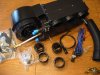
A small auxiliary panel was made to accommodate the controls for the heater and AC system, as noted in a previous post. One switch operates the fan, a second the AC temperature, and the third is a pull switch to control the water flow for the heater temperature. The fire system lever occupies the first position.

The AC / Heater blower uses a lot of power. It has four positions: off, low, medium and high. Using the charger amp gauge as a crude indicator, the high position draws around ten or more amps of power. That seems like a lot of power to draw through a small dash switch, so we decided to use the extra relay included with the Painless fuse box for the high speed blower circuit. We shortened the three wire harness going from the switch to the AC / heater unit, rewiring the orange – high speed blower wire into the relay circuit.
Attached Images
File Type: jpg Dash100807H.JPG (136.0 KB, 1222 views)
File Type: jpg Dash100807B.JPG (143.0 KB, 1204 views)
File Type: jpg DiagramFuel Pump Fan Comp.jpg (14.9 KB, 1189 views)
CESLAW is offline  
Digg this Post!Add Post to del.icio.usBookmark Post in TechnoratiFurl this Post!
Reply With Quote
Old 10-22-07, 10:30 PM   #46 (permalink)
CESLAW
Gold Supporter
United States
 
Join Date: Oct 2006
Location: Illinois
Posts: 313
Rep Power: 5 CESLAW is a glorious beacon of light
Re: Chuck and Ryan's RCR Build

A little extra

A little item that not much thought is given to, until you need it, is a power jack. Since most of our driving will be on the street, not the track, it seemed like a good idea. West Marine provides a nice water proof unit with a cover which blends in well. Marinco Model # 343576. We mounted it on the passenger side where anything plugged in would be out of the driver’s way, carefully centering it directly below the vent for aesthetic purposes. The radio “switched” power source and a separate ground were connected.
Attached Images
File Type: jpg DashPowerPlug.JPG (104.2 KB, 1146 views)
CESLAW is offline  
Digg this Post!Add Post to del.icio.usBookmark Post in TechnoratiFurl this Post!
Reply With Quote
Old 10-22-07, 10:59 PM   #47 (permalink)
Dalton
4 Tenths
Australia
 
Join Date: Jul 2005
Location: Sydney, Aust.
Posts: 420
Rep Power: 8 Dalton is just really nice
Re: Chuck and Ryan's RCR Build

Lovely. This will be one usable car.

Dalton
Dalton is offline  
Digg this Post!Add Post to del.icio.usBookmark Post in TechnoratiFurl this Post!
Reply With Quote
Old 10-27-07, 11:31 PM   #48 (permalink)
CESLAW
Gold Supporter
United States
 
Join Date: Oct 2006
Location: Illinois
Posts: 313
Rep Power: 5 CESLAW is a glorious beacon of light
Re: Chuck and Ryan's RCR Build

Wiring, Part IV, Blinkers and Hazard Warning Lights

Perhaps the biggest wiring challenge was getting the blinkers and hazard warning flashers to work properly. With a GM style column mounted switch it is simple. But with a Lucas turn signal and single pole switches to activate the hazard flasher, it is a challenge.

The objectives were: (1) blinkers would work only when the ignition was “on”; (2) hazard warning lights would work when ignition was off; (3) if the blinkers were turned on, either left or right, and one then turned on the hazard warning flashers, the hazard warning flashers would override the blinkers; (4) The turn signal indicators would indicate function, with both left and right blinking when the hazard warning flashers were activated. In short, we wanted them to operate in the same manner as a conventional car.

The solution was found by using three relays and a single throw double pole switch ( the same as is used for the ‘high beam / low beam’ switch, Lucas 34889). Painless relays and brackets were used. The three relays fit nicely next to the fuse box. You can imagine our delight when we flipped the switches and it actually worked exactly as planned!
Attached Images
File Type: jpg DashFuseRelays.JPG (123.1 KB, 1059 views)
File Type: jpg Diagram Blinker Flasher comp.jpg (16.3 KB, 1060 views)
CESLAW is offline  
Digg this Post!Add Post to del.icio.usBookmark Post in TechnoratiFurl this Post!
Reply With Quote
Old 10-28-07, 02:02 PM   #49 (permalink)
ckouba's Avatar
ckouba
5 Tenths
United States
 
Join Date: Feb 2004
Location: Phoenix, AZ, USA
GT40: RCR40-31
Posts: 578
Rep Power: 10 ckouba will become famous soon enough
Re: Chuck and Ryan's RCR Build

Quote:
Originally Posted by CESLAW View Post
You can imagine our delight when we flipped the switches and it actually worked exactly as planned!
That's something that belongs in one of those credit card commercials as "Priceless."

Keep up the good work. You're giving me lots of ideas for my build as well.
__________________
Chris

RCR40 #31 - SBF, ZF, 15" BRM, LHD, Center shift

10 Jan 07 - Picked it up
25 Feb 07 - Body mounted
15 Mar 07 - Motor/trans installed for the first time
30 Mar 07 - Wide track rear suspension installed
05 May 07 - Cage built and installed
June 07 - Sept 07: Sabbatical!!

Oct 07 - today: Never-ending body prep

My Build Thread
ckouba is offline  
Digg this Post!Add Post to del.icio.usBookmark Post in TechnoratiFurl this Post!
Reply With Quote
Old 10-29-07, 08:52 AM   #50 (permalink)
CESLAW
Gold Supporter
United States
 
Join Date: Oct 2006
Location: Illinois
Posts: 313
Rep Power: 5 CESLAW is a glorious beacon of light
Re: Chuck and Ryan's RCR Build

Starter switch

A push button switch just seems natural for a GT 40. Since Lucas switches were selected for other functions, a Lucas push button switch and two position keyed ignition switch (on – off, no accessory position) were selected. Note that the ignition switch can also be used to start the car, the push button simply parrallels the "start" position.

The keyed ignition switch needs to be securely mounted to that it will not rotate when engaged. The flat surface on one side of the threads is intended to accomplish that function, but mounting it in a fiberglass panel seemed destined to it loosening up with time. Accordingly a flat aluminum panel was fabricated from eighth inch stock. We carefully cut a hole undersized and then used a file to enlarge it and make a flat side that would not permit the switch to rotate when the key was engaged. This is a simple solution, which will hopefully keep the switch tightly in place.

The pushbutton switch will be wired directly to the powers source so one can activate the starter even when the ignition is in the “off” position. This will enable one to turn over the motor without starting the car, perhaps to get the oil moving before firing it up. .
Attached Images
File Type: jpg StarterSwitch0507.JPG (133.8 KB, 947 views)
CESLAW is offline  
Digg this Post!Add Post to del.icio.usBookmark Post in TechnoratiFurl this Post!
Reply With Quote
Old 10-29-07, 08:53 AM   #51 (permalink)
CESLAW
Gold Supporter
United States
 
Join Date: Oct 2006
Location: Illinois
Posts: 313
Rep Power: 5 CESLAW is a glorious beacon of light
Re: Chuck and Ryan's RCR Build

Chris:

Your analogy to a credit card commercial is quite appropos on several different levels!!

Chuck
CESLAW is offline  
Digg this Post!Add Post to del.icio.usBookmark Post in TechnoratiFurl this Post!
Reply With Quote
Old 11-04-07, 08:32 AM   #52 (permalink)
CESLAW
Gold Supporter
United States
 
Join Date: Oct 2006
Location: Illinois
Posts: 313
Rep Power: 5 CESLAW is a glorious beacon of light
Re: Chuck and Ryan's RCR Build

Wiring, Part V, Gauges

With the switch panels in place, it was time to move on to the gauges, which were straight forward.

The speedometer power source is not wired with the other gauges. A ground and power wire were twisted together. The power source was connected directly to the accessory terminal of the ignition switch and the separate ground will be secured directly to the chassis ground. I am contemplating using a shielded cable or twisted wire for the magnetic pickup. This should minimize the risk of electrical interference.

The speedometer will have to be removed to gain access to the dip switches in order to calibrate it. To facilitate removing it, knurled nuts were used to secure it to the bracket which were finger tightened rather than the nuts that came with the gauges. (Note the picture below). Plugs were used on the light wires so that the unit could be completely removed after the dash was installed. One will be able to reach behind the dash, remove the knurled nuts, and pull out the speedometer to adjust the dip switches without too much difficulty.

A couple of 12 gauge wires were screwed to the brace / buss bar. The opposite ends will be screwed to the chassis, one going to the left and the other to the right side of the chassis. When complete there will be at least three ground wires from the dash assembly to the chassis. A good ground can minimize lots of gremlins.

The kit came with a clock which we want to replace with an oil temperature gauge. Since the oil temperature gauge has not yet arrived, we installed the clock but added an extra pick up wire and the necessary connections for the oil temp gauge so that it will be an easy swap. The clock actually keeps pretty good time! The “always on” radio power source was used to energize the clock. The red reset switch was mounted just to the right of the steering column on the bottom of the dash, where it is out of sight.
Attached Images
File Type: jpg SpeedometerB.JPG (126.1 KB, 863 views)
CESLAW is offline  
Digg this Post!Add Post to del.icio.usBookmark Post in TechnoratiFurl this Post!
Reply With Quote
Old 11-04-07, 08:41 AM   #53 (permalink)
CESLAW
Gold Supporter
United States
 
Join Date: Oct 2006
Location: Illinois
Posts: 313
Rep Power: 5 CESLAW is a glorious beacon of light
Re: Chuck and Ryan's RCR Build

Wiring Part VI, Finishing Touches

With the wiring done, wire ties were used to tightly secure everything. The main group of wires was also tied to the buss / brace referenced earlier. On the left and right sides of the dash a padded clamp was used to securely hold the harness.

Although perhaps overkill, we opted to put plugs on the wires. The wires were grouped into front and back and then separated into logical groups with a variety of two, four and six wire plugs, switching the male and female portions so that it would be even more obvious which ends go together.

We checked all the circuits, except the tach and speedometer input, with the dash setting on the dining room table. A battery charger was used as a power source. Simply grounding the oil pressure and water temp sending wires will show a full scale movement. Tooting the horn got the family’s attention real quick. The fuel sending units were temporarily hooked up, revealing that the sending units are mounted up side down and will need to be flipped over before they are installed in the tank. We marked with a pencil the relative location of “half full” so we can accurately calibrate the sending units when installed. Lights, blinkers, hazard flashers all worked as intended. The dash lights put out a nice glow, which provides a bit of illumination on the switches as well. Nice set up!

Dash completed, we decided to test fit it in the car. As the picture below shows, the control panel under the dash is fairly inconspicuous, other than that bright red “FIRE” knob. A bit more trimming and fitting of the aluminum chassis was needed to clear the vents, but nothing troublesome. Just for fun we put in the carpet, seats, hung the doors and put on the front clip. Ryan and I took a test sit. It really feels good!
Attached Images
File Type: jpg DashRightClamp.JPG (179.2 KB, 866 views)
File Type: jpg DashLeftClamp.JPG (135.9 KB, 853 views)
File Type: jpg DashPlugsLeft.JPG (186.8 KB, 864 views)
File Type: jpg DashTestFit.JPG (107.3 KB, 872 views)
CESLAW is offline  
Digg this Post!Add Post to del.icio.usBookmark Post in TechnoratiFurl this Post!
Reply With Quote
Old 11-04-07, 10:28 AM   #54 (permalink)
Rob
VintageVenom's Avatar
VintageVenom
5 Tenths
United States
 
Join Date: Oct 2005
Location: Michigan, USA
GT40: RCR-40
Posts: 598
Rep Power: 10 VintageVenom has much to be proud ofVintageVenom has much to be proud of
Re: Chuck and Ryan's RCR Build

Chuck as consistent with the rest of your build to date, your attention to detail and logical approach is top notch. You keep the rest of us on our toes man..... Well done!
__________________
Rob

aka "VintageVenom"
RCR40 289/webers/ZF -- BUILD THREAD --

www.vintagevenom.com
VintageVenom is offline  
Digg this Post!Add Post to del.icio.usBookmark Post in TechnoratiFurl this Post!
Reply With Quote
Old 11-04-07, 10:51 AM   #55 (permalink)
Bill D's Avatar
Bill D
I Have No Life
United States
 
Join Date: Sep 2001
Location: Camarillo, CA
Posts: 2,381
Rep Power: 33 Bill D has much to be proud ofBill D has much to be proud of
Re: Chuck and Ryan's RCR Build

Ditto to what Rob said
__________________
Bill D
RCR GT40 Mk1 Gulf
Bill D is offline  
Digg this Post!Add Post to del.icio.usBookmark Post in TechnoratiFurl this Post!
Reply With Quote
Old 11-04-07, 02:16 PM   #56 (permalink)
jjs
Rookie
Finland
 
Join Date: Jan 2007
Location: Finland
Posts: 64
Rep Power: 2 jjs is on a distinguished road
Re: Chuck and Ryan's RCR Build

Beautiful...
__________________
Escort RS Cosworth -93 Motorsport Edition
Sierra RS Cosworth 2D -86 --> RS500
Sierra RS Cosworth 2D -86 GrA ex-works rallycar
jjs is offline  
Digg this Post!Add Post to del.icio.usBookmark Post in TechnoratiFurl this Post!
Reply With Quote
Old 11-11-07, 10:20 PM   #57 (permalink)