MK-I MK-II MK-III MK-IV GULF MIRAGE J-CAR LOLA
| Notices | Hi member,
welcome to GT40s.com! If you've never posted on the forum maybe give it a go by introducing yourself in the Introduce Yourself Here forum. Also, think about becoming a Forum Supporter at GT40s.com. Becoming a supporter will allow you more PM space, an avatar, and the money is used to keep GT40s.com running.
Enjoy the forum!
Welcome to the GT40s.com, the World’s Largest GT40 resource.
You are currently viewing our boards as a guest which gives you limited access to view most discussions and access our other features. By joining our free community you will have access to post topics, view pictures, communicate privately with other members (PM), respond to polls, upload content and access many other special features. Registration is fast, simple and absolutely free so please, Join Our Community Today!
Why not start with your first post today and become an active part of GT40s.com now! And, if you find you enjoy GT40s.com think about becoming a Forum Supporter. | | GT40 Build Logs For build threads and build diaries only. |
06-27-08, 11:42 PM
|
#281 (permalink)
| | CESLAW 3 Tenths 
Join Date: Oct 2006 Location: Illinois
Posts: 359
Rep Power: 5  | Re: Chuck and Ryan's RCR Build Eyebrows Installation of the eyebrows was straightforward. A pattern was made to evenly space four holes in the eyebrow, a quarter inch from the bottom to assure the screws would not interfere with the door. One-sixteenth inch holes were drilled, then the eyebrows were set in position and one-sixteenth holes drilled into the spider to assure a perfect alignment. Four Nutserts were used on each side to provide a solid connection for the screws. Stainless steel button head 8-32 screws worked well. The holes in the eyebrow were drilled slightly oversized to give a tiny bit of adjustment, although little adjustment proved necessary. The eyebrows were sanded with a taper on the bottom side to assure the door would not hang up, particularly on the aft end of the eyebrows. The eyebrows were placed so that the door would not come in contact with the eyebrow until it was fully closed. The taper on the eyebrow makes this possible, thus avoiding visible scratches on the edge of the door once the car is painted. |
| |
06-29-08, 02:19 PM
|
#282 (permalink)
| | ckouba 5 Tenths 
Join Date: Feb 2004 Location: Phoenix, AZ, USA GT40: RCR40-31
Posts: 592
Rep Power: 10  | Re: Chuck and Ryan's RCR Build Quote:
Originally Posted by CESLAW Keith:
Although the ducts on the fender are opened, they are only for looks. No plans to use them as air intakes since the dash side vents hook to the AC unit. Of course, that could change . . . .
The vent at the top center of the front clip, which would normally vent to the top dash vent, has not been cut out. Doing so would create a path for water to go places we don't want water to go. So we will likely leave it closed and paint that area flat black. But I can't decide for sure since not opening it up just does not look quite right. Suggestions???? | Chuck,
I did a little work in this regard. I constructed a pattern for a "manifold" which I made out of fiberglass and then glassed into the backside of the clip. The pics are pretty self explanatory.
For the center duct, I brought it back to the trail edge of the clip (again, see photo) and then popped a hole in it on the right side to connect with that manifold. I also opened up holes in the headlight boxes to help feed air into the system (enters through the front brake cooling openings) and you can see the ductwork I fabbed up for that.
All this still needs to be connected to the chassis but my plan for that is to build and glass on another feature which will incorporate a water trap and a reasonably sealed connection upon simply closing the clip. The angled face on right side of the mono is where I intend to make this connect but haven't installed my AC yet so it will wait til that's finalized. I did wipe a visible circle in the dust on the mono where I intend to connect it just to illustrate it. From there it'll be connections like Bill D's to get to the HVAC system. |
| |
06-29-08, 08:31 PM
|
#283 (permalink)
| | CESLAW 3 Tenths 
Join Date: Oct 2006 Location: Illinois
Posts: 359
Rep Power: 5  | Re: Chuck and Ryan's RCR Build Chris:
You have done an impressive amount of work on your ducts. Thanks for the info. For now ducting has been pushed back to the B list, although the holes are at least cut. |
| |
06-29-08, 08:40 PM
|
#284 (permalink)
| | CESLAW 3 Tenths 
Join Date: Oct 2006 Location: Illinois
Posts: 359
Rep Power: 5  | Re: Chuck and Ryan's RCR Build Good News - Bad News - Good News - Bad News - Good News. The good news: We are ready for paint. Took the sanded and trimmed panels outside to let them soak up a bit of sun before loading them up for the trip to St. Louis The bad news: the body panels won't fit on my neighbors trailer, which we had arranged to barrow. The good news: I have a covered trailer on order. The bad news: The trailer won't be ready for two weeks. The good news: There is still lots to do, like fitting the headlight covers and windows, while the body is still here. |
| |
06-29-08, 09:00 PM
|
#285 (permalink)
| | MReid 4 Tenths 
Join Date: Apr 2007 Location: Connecticut GT40: RCR Mk1
Posts: 468
Rep Power: 6  | Re: Chuck and Ryan's RCR Build Now you are moving to the really exciting part!
Soooo, what ya thinking for colors?
__________________ Have fun with your build! - Mark FFR Daytona Coupe RCR Gt40 Mk1 in the garage, and underway! |
| |
06-29-08, 09:19 PM
|
#286 (permalink)
| | gt40fran Sponsoring Vendor 
Join Date: Sep 2001 Location: Manufacturer of GT40: Michigan,USA
Posts: 2,910
| Re: Chuck and Ryan's RCR Build Ray will do a stellar job on that thing...exciting stuff...
__________________ FRAN HALL replica manufacturer.....
RCR-40..Mk1, 2 and Mk4
RCR-70 Mk3b
RCR-70 Spider
RCR-P4
Superlite Coupe
Superlite Roadster...including Electrolite
RCR917
XJ13 for SCF www.RACECARREPLICAS.COM www.superlitecars.com |
| |
06-29-08, 11:19 PM
|
#287 (permalink)
| | CESLAW 3 Tenths 
Join Date: Oct 2006 Location: Illinois
Posts: 359
Rep Power: 5  | Re: Chuck and Ryan's RCR Build Quote:
Originally Posted by MReid Now you are moving to the really exciting part!
Soooo, what ya thinking for colors? | Current plan is Guardsman Blue - same as on #38 Shell car, but without the stripe (at least for now). Will have the rocker panel "FORD" stripe. But plans do change . . . . |
| |
06-29-08, 11:21 PM
|
#288 (permalink)
| | CESLAW 3 Tenths 
Join Date: Oct 2006 Location: Illinois
Posts: 359
Rep Power: 5  | Re: Chuck and Ryan's RCR Build Quote:
Originally Posted by gt40fran Ray will do a stellar job on that thing...exciting stuff... | Ray's Gulf GT is a work of art. I was delighted when he agreed to paint mine.
Chuck |
| |
06-30-08, 09:57 PM
|
#289 (permalink)
| | CESLAW 3 Tenths 
Join Date: Oct 2006 Location: Illinois
Posts: 359
Rep Power: 5  | Re: Chuck and Ryan's RCR Build Rear Clip Hinges Four quarter inch thick pieces of aluminum are bolted, two on each side, to the rear clip to provide the securing point for the hinge bolts. There was about an eighth inch variation where the sections of fiberglass come together inside the clip right at the spot where the aluminum plates are located. To even the surface a sixteenth inch thick piece of hobbyist plywood was cut to size and fiber glassed in place. We extended the fiberglass matting down to the rear of the clip to reinforce the seam where the liner and the rear clip meet. This gave us an even, solid surface to which to bolt the aluminum brackets. The chassis mounting brackets have slotted holes so that they can be adjusted up and down, fore and aft, and left to right. With the clip resting on the car and the rear of the clip supported with jack stands at the exact height, the chassis mounting brackets were placed in the midpoint of their up and down, fore and aft, adjustment range. The two long rear support brackets where loosened about a quarter inch so that they could be used for ‘fine tuning’, either up or down, once everything was firmly in place. (See picture). Then the bolt hole was marked on the aluminum plates, the clip lifted off the car, and the holes drilled. One could use a long bolt with lots of washers as spacers, but doing so makes adjustment difficult and is not a very “clean” approach. Instead, on each side we ran a bolt from the outside in, and then placed washers and nuts on both sides of the bracket mounted on the chassis. This secures the bolt to the chassis so that it pivots on the clip side of the bolt. It is very secure and it is not dependent on washers for alignment. Further, the clip can be easily shifted left or right by simply loosening the nuts to shift the bolt in or out, which is much easier than loosening and moving the small screws securing the mounting brackets to the chassis. A bit of a turn on the long support brackets gave us the fine up and down tuning that resulted in an excellent alignment of the clip. Twisting those tubes a tiny bit is much easier than loosening and adjusting the screws on the chassis bracket. All of the pictures are the right / passenger side. |
| |
07-08-08, 11:19 PM
|
#290 (permalink)
| | CESLAW 3 Tenths 
Join Date: Oct 2006 Location: Illinois
Posts: 359
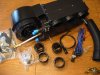
Rep Power: 5  | Re: Chuck and Ryan's RCR Build Body Prep, Supplies With the body panels in place and aligned it was time to move on to the body paint prep. We used only hand tools; no power tools for this delicate operation. The following supplies were utilized. At the risk of sounding like a broken record, Ryan and I have no prior experience whatsoever with this sort of work, so our approach may not be the best, but it did seem to work. So take our comments for what they are worth. The following information may be a bit elementary for most readers, but hopefully it will be of some value to fellow rookies. The sanding supplies included an assortment of Dura Block sanding blocks purchased from our local NAPA store. They are great. They are made from a semi hard rubber-like material so the flex a bit. They are a bit pricey, but well worth it. They obviously come in flat blocks, but also come in round blocks. The round block was particularly useful for edges and irregular surfaces. A roll of 180 grit adhesive backed paper was used for general sanding of the gel coat to smooth out seams and make a nice surface for the primer / sealer coat. It took Ryan more than three days to sand the entire body. Hopefully this will make the painter’s job that much easier. 3M 40 grit and 80 grit adhesive backed paper were used for removing large amounts of material. Be careful of the 40 grit: it really takes off a lot of material fast. The left leading edge of the rear clip had to have as much as 3/8” removed in one area, so the 40 grit worked well in that application. Otherwise the 80 grit is more than adequate. To assure straight edges on the doors and clips, Scotch blue vinyl tape was used. This is much better than masking tape because it is flexible and can be stretched in a nice straight line. It provides an excellent reference point for sanding edges. We used one eighth, one quarter and three eighths inch widths in different locations. We tried a couple of different fillers, but found that Evercoat Rage worked well. It mixes nicely, goes on easily, sets up quickly, and provides a smooth surface that sands out smooth. The blue color contrasted nicely with the white body making it easy to see what we had done. Finally, a 3/16” thick washer was used as a reference for our seam widths. It is indeed possible to have consistent seams of that width. The washer makes it a lot easier to make sure the seams are the correct width. |
| |
07-08-08, 11:27 PM
|
#291 (permalink)
| | CESLAW 3 Tenths 
Join Date: Oct 2006 Location: Illinois
Posts: 359
Rep Power: 5  | Re: Chuck and Ryan's RCR Build Body Prep, Sanding and Filler With the body panels in place and aligned it was time to move on to the body paint prep. We divided this into three parts: (1) overall sanding of the body, (2) sanding the panel edges to achieve the desired gap width, and finally (3) filler, to adjust imperfections in mating surfaces and panels. Ryan spent more than three days sanding all the body panels. All of the mould / parting lines were sanded smooth. Irregularities were sanded out. The entire body was sanded to a dull finish to provide a good surface for the primer / sealer. 180 grit paper was used. The paper was changed frequently, which is easy to do with the roll of self adhesive paper. The gaps in the panels were gently sanded with the 180 grit paper. They were already reasonably close, but in several areas the panels were closer than 3/16”. Using the washer as a reference, these areas were carefully sanded down. Most of this effort was on the driver side door and the leading edge of the rear clip. In a couple of areas the opening was wider than 3/16”. This was most noticeable on the back portion of the passenger side door on the roof. Adding to the edge of the door is risky, since it is prone to being easily broken off. Instead we built up the door opening about an eighth of an inch over a 12” area. This technique worked very well. The top of the passenger door was slightly warped so that the rear edge would not lie flush with the spider. We sanded away about a 1/16” – 1/8” of the rear portion to help reduce the discrepancy, explaining the lack of white gel coat in the picture. It is not perfect, but it should be acceptable when painted.. The leading edge of the top of the driver side door did not sit perfectly flush. We added a 1/16” – 1/8” of filler to help close that gap. A gap at the base of the A pillar and the door frame was leveled with a bit of filler. The leading edges of both doors where they meet the front clip were built up a bit to make the two surfaces flush. If often took two, three, or even four thin applications of filler to get the correct surface. The area around the rear clip intakes on both sides required some extra work. One needs to align the opening between the door, spider and rear clip. There is a lot of extra glass on the rear clip, so we sanded the fiberglass down until we had a reasonably good alignment. Indeed with careful sanding one can achieve a reasonably good fit without any filler. But be careful not to remove more than necessary or the structural integrity of the panel could be compromised. This is where the round Dura Block and the 80 grit paper work well. One needs to go around the car searching for ‘trouble areas’ and then fix them. This part of the job was fun, because it goes fairly quickly and the results are obvious right away. Indeed it only took a couple of weekends for us to correct all the ‘trouble areas’. In most instances the ‘trouble areas’ were resolved with a thin coat of filler. Additional posts will cover specific issues on the clips and doors. |
| |
07-09-08, 07:31 AM
|
#292 (permalink)
| | Big-Foot Gold Supporter 
Join Date: Jan 2007 Location: Minneapolis, MN GT40: Replica
Posts: 1,388
| Re: Chuck and Ryan's RCR Build Chuck / Ryan - Again - Great documentary on your car...
I'm curious about your doors.. What sort of gap are you getting at the bottoms of the doors to the sills?
Also - Do you recall the thickness of your hinge shims?
Not that I've been appointed to speak for them - but - Thank you on behalf of all GT40 builders! |
| |
07-09-08, 02:56 PM
|
#293 (permalink)
| | EGLITOM 3 Tenths 
Join Date: Sep 2007 Location: Germany GT40: RCR 40
Posts: 364
Rep Power: 6  | Re: Chuck and Ryan's RCR Build great job
i have the DURABLOCK as well and it works great. I will go out now and sand the spray filler on my flares:-))
TOM
__________________ RCR 40 ; LEVY RACING 331; G50/05; gulfwide |
| |
07-09-08, 10:36 PM
|
#294 (permalink)
| | CESLAW 3 Tenths 
Join Date: Oct 2006 Location: Illinois
Posts: 359
Rep Power: 5  | Re: Chuck and Ryan's RCR Build Randy:
I used nylon washers on the bottom and top of the hinge openings where the door meets the bracket. 1/8" thick. The thickness probably won't matter much, since with a thinner washer the hinge would go slightly higher and with a thicker washer slightly lower. With 1/8" washers there will be about 1/8" of 'play' between the door and the top support on the bracket, which is probably good to accomodate any slight up or down movement when the door is closed to seal properly around the weather stripping.
This is detailed on my previous post titled Door Hinges.
The gap on the door bottom is right at 3/16" - same as the spacer between the spider and the rocker panel.
How are you coming along with fitting your body panels?
Chuck |
| |
07-10-08, 08:23 AM
|
#295 (permalink)
| | Big-Foot Gold Supporter 
Join Date: Jan 2007 Location: Minneapolis, MN GT40: Replica
Posts: 1,388
| Re: Chuck and Ryan's RCR Build Hi Chuck,
The hinge shims I was talking about were the ones that go between the hinge and the chassis itself. I reviewed your other write-up (quite good) and would just like to know what shim thicknesses you ultimately ended up with and if you had to use a thinner or thicker shim on the top vs the bottom for proper fitment.
Thanks for the door bottom gap too!!
I'm doing well on mine. I've had some challenges but have basically survived them all. I'll be updating my website soon (I hope).. |
| | |