
Hi all, I am currently getting a match balance carried out on a new flywheel. The engine is a late 302 and as expected, the flywheel has a 50 oz.in correction. The engine always ran smoothly, so I am not questioning the balance, just getting it matched. Some information I saw suggests that the angular position of the flywheel counterweight is not normally where it is on this engine. I believe that this engine could have been a marine engine in its previous life, and when I questioned Copilot, it said that marine engine builders did it differently and 'marine 302s often do use different counterweighting on the crank, even when the casting number is the same as an automotive crank'. Does anyone know of this?
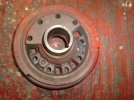
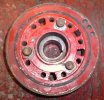
Further information is that although the engine is late 302, it appears to have an early harmonic balancer, I guess that the three holes on the front of the harmonic balancer are part of the balancing process, while the 4 on the back look like they are standard. The early harmonic balancer (28 oz.in) suggests that the balance process was different for this engine and therefore that the counterweighting must have been altered.
Also, the angular position of the flywheel balance weight is where I expect it to be if I calculate the residual moment angle, coincidence or true I'm not sure?
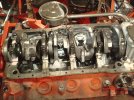
I didn't scrutinise the crankshaft counterweights when I modded the sump years ago, but the attached photo does show drillings in the harmonic balancer end counterweight.
As I said, I am not concerned about the balance, the engine always ran smooth, so match-balancing is the right thing to do. I'm just looking to understand the facts behind this.
So does anyone know about this or have information to clarify all this for me?
Further information is that although the engine is late 302, it appears to have an early harmonic balancer, I guess that the three holes on the front of the harmonic balancer are part of the balancing process, while the 4 on the back look like they are standard. The early harmonic balancer (28 oz.in) suggests that the balance process was different for this engine and therefore that the counterweighting must have been altered.
Also, the angular position of the flywheel balance weight is where I expect it to be if I calculate the residual moment angle, coincidence or true I'm not sure?
I didn't scrutinise the crankshaft counterweights when I modded the sump years ago, but the attached photo does show drillings in the harmonic balancer end counterweight.
As I said, I am not concerned about the balance, the engine always ran smooth, so match-balancing is the right thing to do. I'm just looking to understand the facts behind this.
So does anyone know about this or have information to clarify all this for me?