
Chuck's Jaguar D Type Build

Chuck

Supporter
Headlight Lens, Part III.

Time to find out whether the felt-lined, reinforced fiberglass forms will work.

Our supply of cheap, undersized Plexiglass exhausted, we ordered more, finding material available in a 16” x 20” size. There are two types of acrylic: cast and extruded. As we now discovered, our initial attempts used extruded material. The cast acrylic is more expensive, softens at a higher temperature, is more UV-stable, more scratch-resistant, and has better optical clarity, so it was ordered for the next attempts. From Amazon, of course!

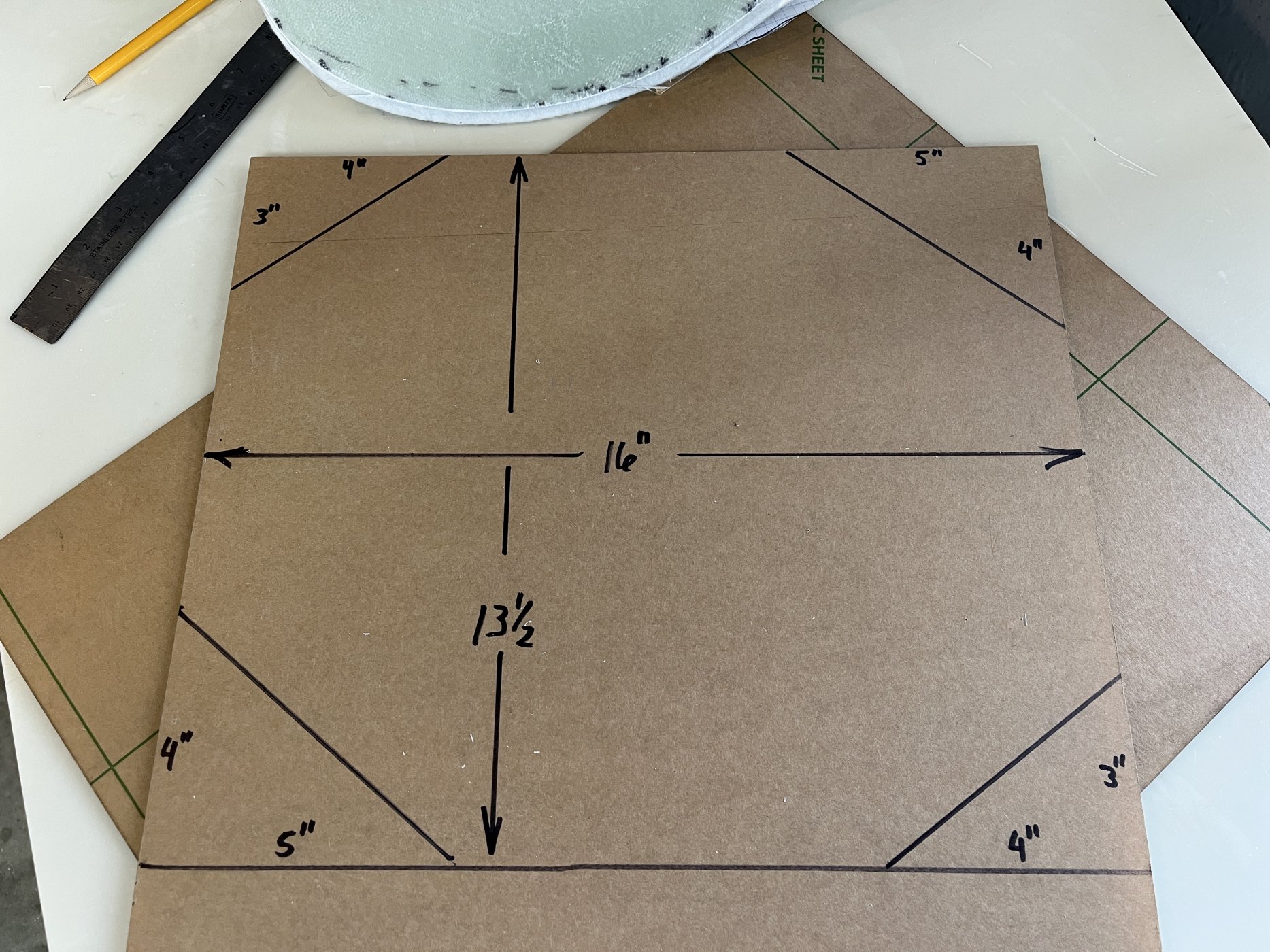
Once trimmed and ready to install on the D-type, the lenses will measure approximately 15” x 12”. The mold measures approximately 16” x 13 1/2 ”, providing a lip where the clips can be applied without warping the final product.

Before molding the plexi, the panels were trimmed to 16” x 13 1/2” and the corners trimmed using the “scribe and snap” technique so they would more closely approximate the mold's dimensions. (One way to tell cast from extruded acrylic is that the former is typically covered with brown paper, while the latter is covered with plastic film.)
IMG_2766.JPG


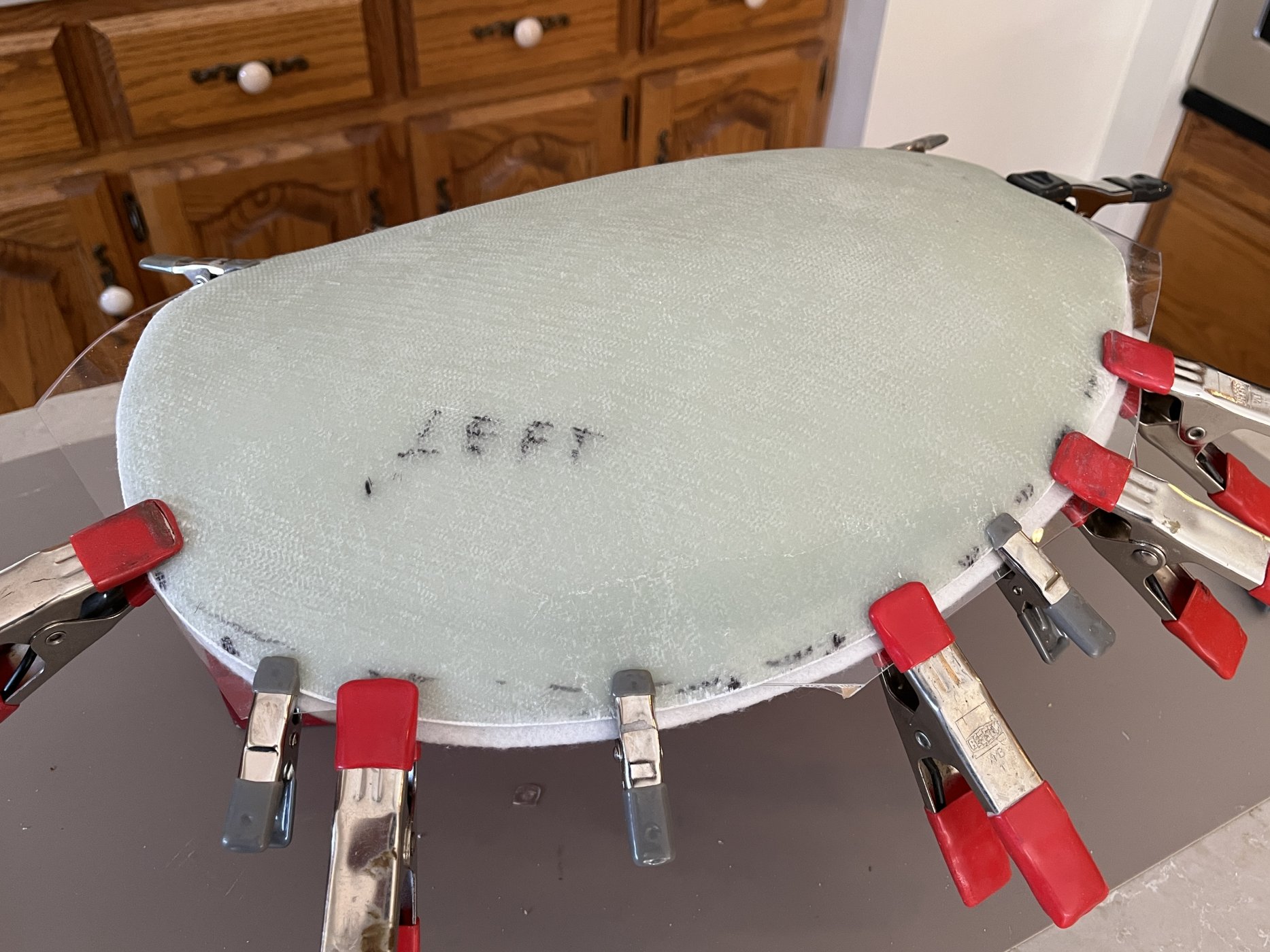
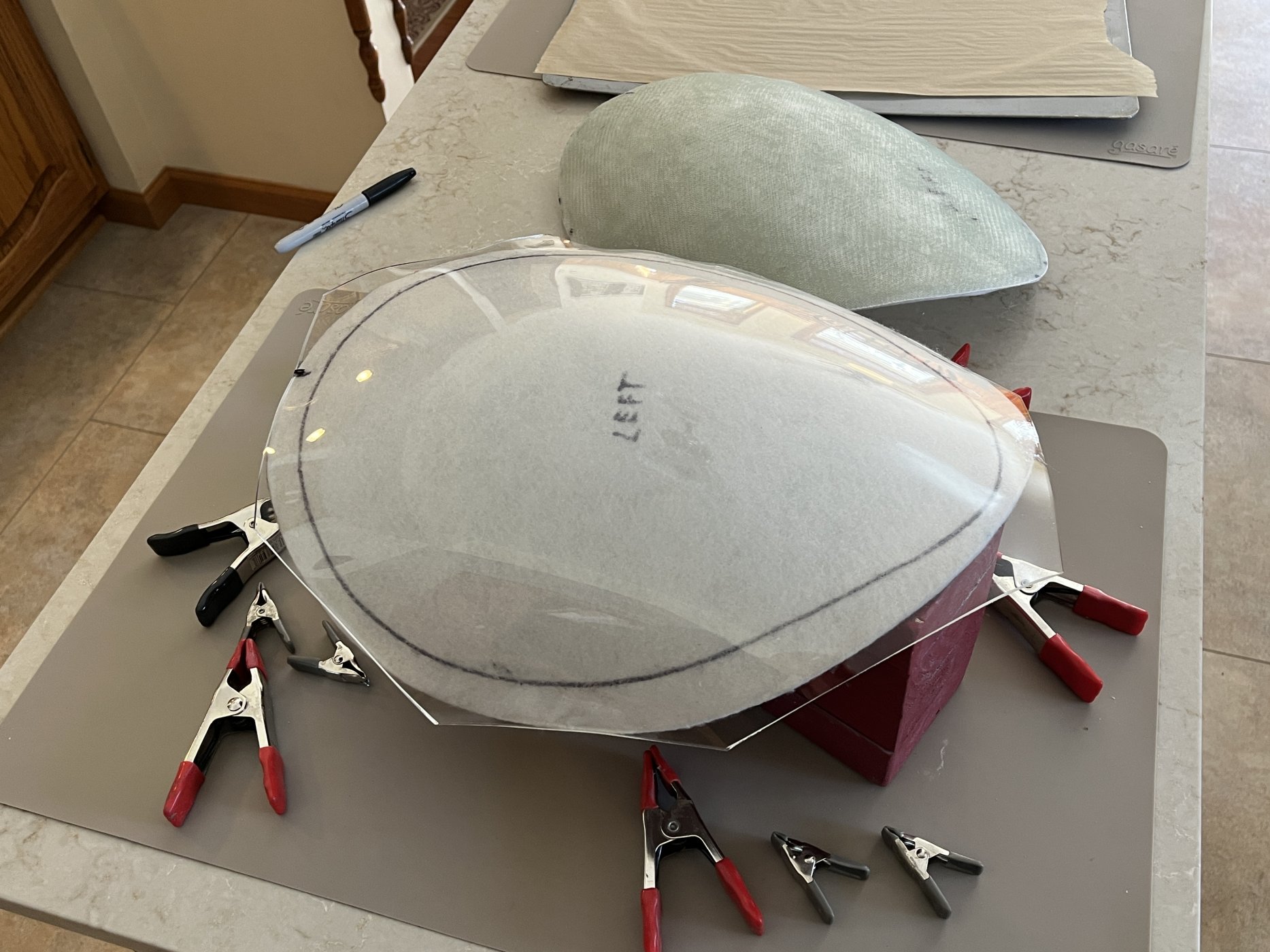
Supplies were set up, the oven preheated to 290 degrees, and the process we had done so many times over the last several weeks was repeated using the male and revised female molds and correctly sized Plexiglass. We quickly discovered that the temperature needed to be increased to 320 degrees because the cast acrylic requires a higher temperature. Instead of 5 minutes, 10 were needed for it to soften sufficiently.
IMG_2762.JPG


After a lot of designing, experimenting, fabrication, and testing, this worked. The plexi matched the mold's shape well, with no defects or imperfections.

IMG_2765.JPG


Next is trimming and fitting.
 

Chuck

Supporter
Headlight Lens, Part IV.

Cutting the lens to shape was next. The failed attempts using extruded acrylic (the same material used by RCR) were trimmed, which proved challenging. A Dremel cutting disc simply melted the material. With much effort, a straight cutting blade on the Dremel worked. A lot of hand sanding was needed to shape these first test pieces. We now know that extruded acrylic is more difficult to fabricate.

The successfully molded cast acrylic was a completely different story. The uncut lens was set in place, and the outline of the opening was traced with a Sharpie. The Dremel cutting disc worked very well for rough cutting, with no melting. A sanding drum made quick work of the last bit of material, followed by hand sanding, first with 40 grit and finally with 180 grit.

IMG_2771.JPG


When we set the trimmed lens in place, we confirmed three things. First, we can make our own headlight lenses. Second, the recess in the body for the lenses is too deep and needs to be revised. Third, we can form the plexiglass using the kitchen oven without my spouse ever knowing what I was up to.

IMG_2619.JPG


Next, the depth of the recess needs to be corrected so the lens fits flush with the body.
 

Randy Folsom

Supporter
Headlight Lens, Part IV.

Cutting the lens to shape was next. The failed attempts using extruded acrylic (the same material used by RCR) were trimmed, which proved challenging. A Dremel cutting disc simply melted the material. With much effort, a straight cutting blade on the Dremel worked. A lot of hand sanding was needed to shape these first test pieces. We now know that extruded acrylic is more difficult to fabricate.

The successfully molded cast acrylic was a completely different story. The uncut lens was set in place, and the outline of the opening was traced with a Sharpie. The Dremel cutting disc worked very well for rough cutting, with no melting. A sanding drum made quick work of the last bit of material, followed by hand sanding, first with 40 grit and finally with 180 grit.

View attachment 152109

When we set the trimmed lens in place, we confirmed three things. First, we can make our own headlight lenses. Second, the recess in the body for the lenses is too deep and needs to be revised. Third, we can form the plexiglass using the kitchen oven without my spouse ever knowing what I was up to.

View attachment 152110

Next, the depth of the recess needs to be corrected so the lens fits flush with the body.
Chuck, maybe I missed it, but why acrylic vs polycarbonate? Cheers, Randy

PS, thx again for providing so much great build inspiration and information.
 
Perhaps a clear silicone material between lens and body. Will seal out moisture and raise lens relative to body.
Blas
 

Chuck

Supporter
Chuck, maybe I missed it, but why acrylic vs polycarbonate? Cheers, Randy

PS, thx again for providing so much great build inspiration and information.
Lexan is a trade name for polycarbonate. Plexiglas is a trade name for acrylic. Lexan is a stronger, more impact-resistant material. But Plexiglas offers better optical clarity, better scratch resistance, easier cutting and shaping, and better UV resistance, making it the better option for these headlight lenses.
 

Chuck

Supporter
It may be deeper then the lens thickness due to a metal retainer for the lens?
The thickness varies around the perimeter. My suspicion is that it is most likely due to deficiencies in the mold and/or the lay-up process during its manufacture. The depth of the recess will not affect the means of attachment, since a nut plate or Rivnut will be used regardless of the depth of the recess.
 

Chuck

Supporter
Headlight Lenses, Part V.

The opening in the body was cleaned first with a Dremel drum sander, then with 80-grit sandpaper. The goal was to make sharper edges and smoother surfaces. However, we discovered that the irregular recessed lip was as much as 3/8” deep: not acceptable if a flush lens cover is the goal.

IMG_2634.JPG


A one-eighth-inch-wide vinyl trim tape was used as a reference to mark the desired depth.

IMG_2637.JPG


Epoxy mixed with “glass balloons” until it reached a peanut-butter consistency was spread on the lip to bring it up to the blue tape line. Once dry, it was sanded and a second layer applied.

IMG_2644.JPG


When finished, we had an even opening into which the lens fit flush.

IMG_2768.JPG


With just a couple of pieces of Scotch tape, the new lenses stayed in place and fit flush around the entire perimeter. Once the 10-32 Truss head screws are installed, they will snug down nicely with minimal tension, but that detail will be deferred until later.

Even if the extruded lens material provided by RCR could have been used, this was a worthwhile six-week adventure. Using cast acrylic produced much better results with a superior material, and it was an interesting learning experience.

Per Ryan’s suggestion, a couple of extra lenses will be molded just in case they are needed down the road.
 

Chuck

Supporter
Bonnet Straps, Part I

We opted for straps on the outside rather than inside the bonnet. Here is an original.

Strap2.jpg


This required closing the recess on the lower section. A vent hole was drilled on the back side. After sanding away material on the sides of the opening to allow fiberglass to be layered flush, a small section of quarter-inch-thick foam, as used elsewhere on the body, was set in place with hot glue. Epoxy and flox mix was applied and sanded to make a smooth, slightly recessed surface for the fiberglass.

IMG_2859.JPG


IMG_2860.JPG


IMG_2866.JPG


Once this had dried, a first layer of fiberglass was applied, then a second, larger layer, to produce a final surface flush with the surrounding area. Later, when the bodywork is done, this will be sanded again, and filler will be added to ensure a smooth surface.

IMG_2877.JPG


With this bit of body work out of the way, the straps will be installed.
 

Neil

Supporter
Bonnet Straps, Part I

We opted for straps on the outside rather than inside the bonnet. Here is an original.

View attachment 152528

This required closing the recess on the lower section. A vent hole was drilled on the back side. After sanding away material on the sides of the opening to allow fiberglass to be layered flush, a small section of quarter-inch-thick foam, as used elsewhere on the body, was set in place with hot glue. Epoxy and flox mix was applied and sanded to make a smooth, slightly recessed surface for the fiberglass.

View attachment 152529

View attachment 152530

View attachment 152531

Once this had dried, a first layer of fiberglass was applied, then a second, larger layer, to produce a final surface flush with the surrounding area. Later, when the bodywork is done, this will be sanded again, and filler will be added to ensure a smooth surface.

View attachment 152532

With this bit of body work out of the way, the straps will be installed.
Not original, but an alternative that works well. -Neil https://www.4statetrucks.com/4-875-...n1DkCmqYIpAA6xOhhrOzi_bEv-42LT0RoCFssQAvD_BwE
 

Chuck

Supporter
Bonnet Straps, Part II.

It amazes me that new D-Type parts are still for sale. Parts we have obtained include the radiator, expansion tank, steering wheel, bonnet, and boot latches, and now the leather straps. Moss Motors sells the pair. They were not cheap, but they are a prominent detail, so we ordered a set. https://mossmotors.com/37-1600pr-leather-bonnet-straps-tan-pair

The original D-type straps had aluminum plates through which the screws passed. A piece of eighth-inch-thick aluminum, 1.5 inches by 2 inches, was cut, and the edges chamfered on the mill to match the look of the original. Holes were drilled for 8-32 stainless steel countersunk screws. A punch made cutting the holes in the straps a quick job.

1774296953229.jpeg


Looking at the different originals, differences in how the straps were installed can be seen. We centered the strap between the latch screws and the aft edge of the bonnet. A bit of slack was left, being careful not to make the strap too tight, so it can be undone when in place.

1774296979301.jpeg


Another little detail done.
 
Headlight Lenses, Part V.

The opening in the body was cleaned first with a Dremel drum sander, then with 80-grit sandpaper. The goal was to make sharper edges and smoother surfaces. However, we discovered that the irregular recessed lip was as much as 3/8” deep: not acceptable if a flush lens cover is the goal.

View attachment 152189

A one-eighth-inch-wide vinyl trim tape was used as a reference to mark the desired depth.

View attachment 152190

Epoxy mixed with “glass balloons” until it reached a peanut-butter consistency was spread on the lip to bring it up to the blue tape line. Once dry, it was sanded and a second layer applied.

View attachment 152191

When finished, we had an even opening into which the lens fit flush.

View attachment 152192

With just a couple of pieces of Scotch tape, the new lenses stayed in place and fit flush around the entire perimeter. Once the 10-32 Truss head screws are installed, they will snug down nicely with minimal tension, but that detail will be deferred until later.

Even if the extruded lens material provided by RCR could have been used, this was a worthwhile six-week adventure. Using cast acrylic produced much better results with a superior material, and it was an interesting learning experience.

Per Ryan’s suggestion, a couple of extra lenses will be molded just in case they are needed down the road.
You are holding the lenses in place with screws into the fiberglass instead of rivnuts, or some other type of insert? Did you thicken the fiberglass surround in that area? I still haven;t decided how I am going to attach mine on my GT40.
 
You are holding the lenses in place with screws into the fiberglass instead of rivnuts, or some other type of insert? Did you thicken the fiberglass surround in that area? I still haven;t decided how I am going to attach mine on my GT40.
i used these for my gt40 lens and will be using them for side screens
( Thread Adapter Fitting Reducer Threaded Inserts )

m4 inner, m6 outer length 8 mm

i locked thm in place with thread lock

Jerry
 

Chuck

Supporter
Good tip Jerry. Since there are only three screws on the D-Type, my current plan was to use Riv Nuts designed for "soft" materials. The thread adapters you used would work well and fit flush. Thanks for the info.

Joe, the surface on which the Riv Nuts will be mounted is indeed thickened, from more than 1/8 to 1/4 inch or more.

Joe, when I built the RCR GT40, I placed the screws directly into the fiberglass on the headlights and side glass. There are many more screws than on the D-Type, so going directly into the fiberglass has worked well. Sixteen years later the side glass and headlights are holding secure with no issues. Inserts could always be added later if needed. Here is a link. https://www.gt40s.com/threads/chuck-and-ryans-rcr-build.22083/post-232673
 
Last edited:

Chuck

Supporter
Fuel Filler Door, Part I

A lot of time was spent deciding how to secure the fuel filler door, including consideration of an original-style, simple spring-type release. We finally decided to go with a spring-loaded grab latch from McMaster-Carr, part number 1659A7. This is a small 304 stainless steel unit that holds tightly. But it requires secure support and careful alignment. Plans were drawn.

1774886187386.jpeg


The bracket was made from .040 aluminum. Time was spent trimming until it fit well.


IMG_3051.JPG


IMG_3052.JPG


The fiberglass adjacent to the latch mechanism was thinned to about 1/16” to maximize the ‘grab’ on the latch pin. The bracket was set in place to confirm the fit.

IMG_2997.JPG


The bracket is held in place with 6-32 countersunk screws. Tinnerman washers were placed using the same technique as described in previous posts. These provide sturdy support for the screws, preventing stress on the fiberglass.

With the Tinnerman washers in place, a single layer of fiberglass was applied to the underside of the surface to provide additional strength. Epoxy mixed with flox was applied on the top side to ensure a smooth surface around the washers.

IMG_3087.JPG


Next is the installation of the latch grab pin.
 

Chuck

Supporter
Fuel Filler Door, Part II

A 1/8” thick aluminum plate was cut and holes drilled for the two rivets holding the pin in place and the two countersunk screws holding it to the fuel filler door.

Rivets 1/8” x ¼” were used to secure the latch pin.

IMG_3049.JPG


IMG_3050.JPG


The assembly was recessed by trimming away material until only 1/16” remained, because this assembly will determine the door opening’s gap. A layer of fiberglass was then placed on the back side to reinforce this area. The edge that had been sanded away to recess the plate was filled with an epoxy-and-flox mix. The two extra holes provide clearance for the shop side of the rivets. The center hole was used to locate the center point on the grab latch and, once assembled, it serves no further function.

IMG_3078.JPG


A pair of countersunk 6-32 screws holds the plate in place.

IMG_3080.JPG


Almost done.


Randy V

Moderator-Admin
Staff member
Admin
Lifetime Supporter
I don’t comment often - but I never miss a chance to review your progress on this fantastic effort… Thanks for sharing it with us!
I saw that you swapped the slotted screws for philips heads and was curious why…
One of the things that I really didn’t enjoy about working on old British cars was that they seemed to use a lot of slotted screws and almost always had a very shallow slot..
 
Back
Top