Help designing EFi fuel system

Brian Kissel

Staff member
Admin
Lifetime Supporter
I remembered that from a few years ago Ian, but I couldn’t remember who made it, and then if it would fit in most narrow bottom tanks. I am definitely going to look into it.

Thanks for reminding me.

Regards Brian
 

Brian

Supporter
Paul,

If there's 1" of fuel in the tank, would that mean there's 1" of fuel in that bucket, or is there any active means to keep it full.

The OEM's include a venturi pump fed by the returned excess fuel flow to scavenge all available fuel from the tank to keep the canister full.

I can't see any similar mechanism here with the pump being separate from the bucket. I just see the filter sock, pump and discharge, then the return.
 
My concern relates to pumps running dry. I really don't see any way to avoid the lift pumps running dry in my case. And probably same for most 40s. Hydramat, baskets, foam, whatever will delay the onset of running dry but eventually they are likely to run dry under some circumstances. In my case I don't see being able to add any of the above items any time soon and it has to be external pumps.

So my simple question is - which external pumps are best at coping with running dry?
 

Ian Anderson

Lifetime Supporter
I remembered that from a few years ago Ian, but I couldn’t remember who made it, and then if it would fit in most narrow bottom tanks. I am definitely going to look into it.

Thanks for reminding me.

Regards Brian
Hi Brian

I remember from years back they also said they would do custom sizes…..not sure if they ever did.

I would have thought a full length piece with pick-up point to meet the application would be great.

If designing a tank now I would have a mid tank pick up so even under braking /accelerating/uphill/downhill it would have the best chance of sucking fuel.

But I did run a GT40 with fuel injection for 15 years so know of system shortcomings.

Ian
 
Last edited:

Brian

Supporter
All of the newer turbine type EFI pumps are fairly tollerant of momentarily running dry. Unless your set on a period correct looking pump, this is what I would use. Bosch 044 or walbro 255 or 340 are solid and reasonably priced. If you're feeding more than 500 HP, run2 in parallel and you have some redundancy.

Today, there's no way I would use a vane pump.
 

Paul Proefrock

Moderator
Staff member
Admin
Supporter
Paul,

If there's 1" of fuel in the tank, would that mean there's 1" of fuel in that bucket, or is there any active means to keep it full.

The OEM's include a venturi pump fed by the returned excess fuel flow to scavenge all available fuel from the tank to keep the canister full.

I can't see any similar mechanism here with the pump being separate from the bucket. I just see the filter sock, pump and discharge, then the return.
Brian, they offer two different systems.

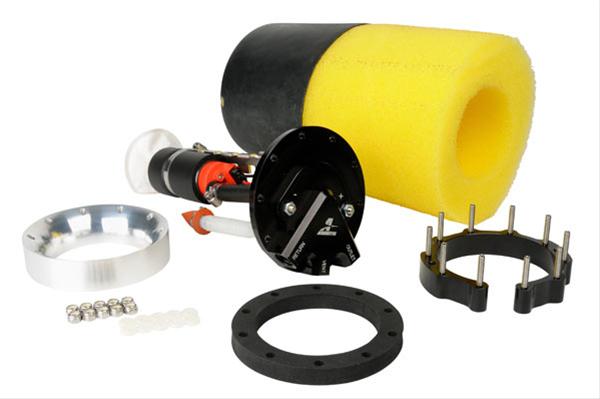
On the standard, the fuel return goes into the bucket keeping it full. There are ports at the bottom of the bucket to allow fuel inlet as needed and you can add one-way valves if desired.

On their siphon system, they also included a siphon valve that could be placed in the second tank to flow fuel to the first, much like is done on the late model Corvettes. The guys at Aeromotive don't believe the siphon system is needed on our application although it could be added at a later date.
 
Put a gas pressure gauge on the dash board if it is a so big concern and forget all the discussion on running dry. Consider that you ar not blind and on top of this you already have the tank level gauge. :)
 

Ian Anderson

Lifetime Supporter
Off course you will still also need to consider where you put the O2 sensor in the exhaust so the ecu can tell if it is fuelling correctly.

Sounds simple enough but with a cross over exhaust you will need to use slip joints to attach the 4 into 1 Merge collectors to the primary headers. These will LEAK and suck air in during part of the cycle and hence give the ECU incorrect readings. You should definitely look at Double Slip collectors to cut down the possibility of air ingress.
 

Kevin

Supporter
The Aeromotive Phantom systems incorporate a 'bucket' around the pump that serves as both a reservoir and a baffle.

Anyone install a set of these in an RCR? I see the comment about the CAV but I have no idea if the tanks are setup similarly. I've reached out to Aeromotive, but no response yet. They also have an "Apex" variant that adds a remote pickup tube that may prove very useful for us.

Also not sure if a swirl tank is really needed with this approach, but if so, anyone source a tank well suited for GT40s?
 

Paul Proefrock

Moderator
Staff member
Admin
Supporter
Kevin
I've set up my RCR40 for arrangement. I have also spoken to Aeromotive and have two other builds with them in Cobras. My comments
  • To run one, the tanks must act as a single unit. I've added a 16AN cross-over line at the forward edge of the engine cutout. The line links the two tanks at their lowest point. I am confident the line size will keep the tanks in balance. This isn't the easiest mod to an RCR chassis but it is doable.
  • While speaking with Aeromotive, I asked about the venturi for the slave tank. The tech said he didn't feel it would be necessary but it could be added at a later time if I wanted or if there became an issue
  • With that arrangement, a swirl tank is not needed; the pump unit basket serves that purpose.
  • I've got about 20,000 miles on two different cobras using the Phantom system. No issues.
 

Randy Folsom

Supporter
Anyone install a set of these in an RCR? I see the comment about the CAV but I have no idea if the tanks are setup similarly. I've reached out to Aeromotive, but no response yet. They also have an "Apex" variant that adds a remote pickup tube that may prove very useful for us.

Also not sure if a swirl tank is really needed with this approach, but if so, anyone source a tank well suited for GT40s?
An in tank baffle (bucket or blade) will help protect the pump from running dry on down hill runs. That will also eliminate the need for a swirl tank.

I cut away the aft top section of my tank and then welded on a 1/4” plate to the top. That provided me both a mounting surface for the pump and an opportunity to insert a blade baffle about 6” inches in. It’s a few inches tall with the lower corner cut off to allow fuel to flow into the baffled area. The baffle is visible through the pump hole.

1783911175142.jpeg
 

Kevin

Supporter
Kevin
I've set up my RCR40 for arrangement. I have also spoken to Aeromotive and have two other builds with them in Cobras. My comments
  • To run one, the tanks must act as a single unit. I've added a 16AN cross-over line at the forward edge of the engine cutout. The line links the two tanks at their lowest point. I am confident the line size will keep the tanks in balance. This isn't the easiest mod to an RCR chassis but it is doable.
  • While speaking with Aeromotive, I asked about the venturi for the slave tank. The tech said he didn't feel it would be necessary but it could be added at a later time if I wanted or if there became an issue
  • With that arrangement, a swirl tank is not needed; the pump unit basket serves that purpose.
  • I've got about 20,000 miles on two different cobras using the Phantom system. No issues.
My intent is to run the two tanks separately, so I would in theory use two of these setups (one in each tank) and then use a Pollak Valve to switch between them. I'm just trying to determine if a Swirl Tank is needed after the Pollak or not. Seems "maybe" depending on how likely whichever tank is feeding the Pollak runs dry.

As for the Phantom Apex setup, I didn't get the impression it was setup to run the pickup to an entirely different tank. Looks to be setup to run a pickup to elsewhere in the same tank using their Jet Pump.

Sounds like the Aeromotive units are well built, based on your Cobra experiences.
 

Randy Folsom

Supporter
My intent is to run the two tanks separately, so I would in theory use two of these setups (one in each tank) and then use a Pollak Valve to switch between them. I'm just trying to determine if a Swirl Tank is needed after the Pollak or not. Seems "maybe" depending on how likely whichever tank is feeding the Pollak runs dry.

As for the Phantom Apex setup, I didn't get the impression it was setup to run the pickup to an entirely different tank. Looks to be setup to run a pickup to elsewhere in the same tank using their Jet Pump.

Sounds like the Aeromotive units are well built, based on your Cobra experiences.
Consider using the Pollak valve for the return where the pressure is lower, then install check valves on the feed lines. Both feed lines go into a Y fitting then go through a common filter to the regulator. The regulator return goes to the Pollak valve. There is one repurposed wiper switch; up for DS, down for PS, middle for no pump. The same switch will switch the ground on the Pollak valve ensuring the return and feed are always the same tank. The Y fitting can be replaced with a swirl tank.

1783992158108.jpeg
 
Back
Top