Bob's EV SLC Build Log

Brian Kissel

Staff member
Admin
Lifetime Supporter
All I can Bob, is Holy Crap, I’m impressed. The amount of thought and engineering going into this project just blows me away.
Excellent job !!!

Regards Brian
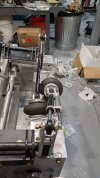
 
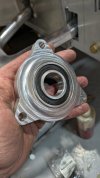
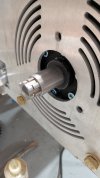
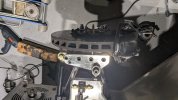
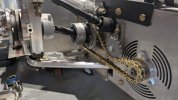
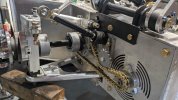
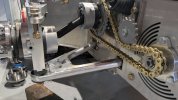
Small update. Finalized the air spring locations, each actuator is on a 4.8 degree angle, and I am adding cantered perches to the springs so they are perfectly in line with the actuator. These are printed but not installed yet. Also added the cover to the front motors, and the front bearing for the sprocket shaft, so the whole drive is in double shear, as recommended by EMRAX. Motor spins freely and with out contact anywhere.

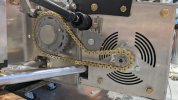
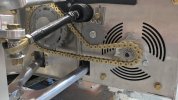
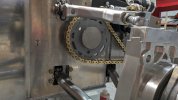
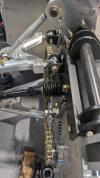
Finally I mocked up the chain drive to where the front axle will be. I had made the sprockets in chromoly, but this is one place where my printed parts worked fine, but the metal ones did not. I think I got the pitch wrong on it. So everything is just 3d printed right now. But...it all fits and clears the A-arms at both bottom and top of travel. Full droop is a little close, but I do not have the chain under tension in these photos. What is mocked up is my worse case from clearance. The rear sprocket is 36T front is 10T, tensioner is 17T.
 

Attachments

  • PXL_20260222_224241521.jpg
    PXL_20260222_224241521.jpg
    205.9 KB · Views: 150
  • PXL_20260222_221540577.jpg
    PXL_20260222_221540577.jpg
    152.6 KB · Views: 127
  • PXL_20260222_221542659.jpg
    PXL_20260222_221542659.jpg
    137.8 KB · Views: 117
  • PXL_20260301_201716840.MP.jpg
    PXL_20260301_201716840.MP.jpg
    375.9 KB · Views: 117
  • PXL_20260301_201603222.MP.jpg
    PXL_20260301_201603222.MP.jpg
    357.2 KB · Views: 112
  • PXL_20260301_201609991.MP.jpg
    PXL_20260301_201609991.MP.jpg
    303.1 KB · Views: 100
  • PXL_20260301_210220950.MP.jpg
    PXL_20260301_210220950.MP.jpg
    169.5 KB · Views: 99

Brian Kissel

Staff member
Admin
Lifetime Supporter
Excellent craftsmanship Bob. The amount of designing and R&D going into this build is incredible.
Please keep us updated.

Regards Brian
 
Sourcing/building actuators for the suspension system. When I started designing the suspension system for this car almost 6 years ago now, there were not too many examples of active suspension systems using mechanical actuators.

The over all idea in these systems is that you place a actuator in between the wheel and the body and use it to compensate for forces on the car and/or travel of the wheel. In a ideal form these systems could theoretically replace springs and dampeners, and keep perfect tire contact with the road service. In practice, as with most things, this is very hard to do. Two things have mostly held up the broad adoption of these systems, the first is operating frequency of the system, which generally needs to be greater that 50 Hz (50 times a second). The second is the speed/force of the actuator, which needs to at least be able to push with the force seen on the tire, and ideally 2-3x, more importantly it needs to be able to move fast enough. For body roll control you need 2-4 inch/sec, and for wheel control you need >10-15 inch per second. These are pretty aggressive numbers for most off the shelf hydraulics/electric actuators, where movement rates are more like 0.5-1 inch/second.

In my research I found a few systems that had data I could bench mark off.

The grand daddy of them all, Williams FW14 F1.
This is the system most people know about, but very little details of the system are public. This is really a body roll control system, it was programable to the track it was running on, and adjusted body position for optimal performance on each corner and straight. You can tell looking at the actuators they are really small, with little travel, and just looking at the system in demos, the body does not move that fast. I think I read somewhere that it had ~5 inch/sec of movement @ 10Hz.

The BOSE system.
This system is truly fully active and adaptive. It used electro actuators and computer control to basically do away with springs. vertical movement of the actuator at reported 50 in/sec and operating frequency of 15-50 Hz back in the late 90's and early 00s Lots of information on the system out there and why it never got adapted to racing. It was ok for road cars, but not worth the weight for racing. The core of this system is now being seen in modern Chinese cars like the BYD U9 and the Nino...I will show so videos of its action, very impressive.

The German FSAE team.
and
While not a active system, this team built a fully decoupled body roll system using hydraulics. When you watch the videos of their car, you start to understand the power of these systems, even if we are just addressing body roll.

When you start to think about it, suspension systems on cars are incredibly out of date compared to improvements in almost all other aspects of a vehicle. I think suspension is going to be the next really big differentiator for cars, as HP and torque become pretty much the same for every model. Right now 700 HP is nothing these day, and 0-60's under 3 are the norm. Moreover, in the EV world, most cars a traction limited, HP and torque are available in such excess that speed now really depends on tires and suspension. Gas cars are also converging on this singularity too, but are probably 5 years behind. All that said, I know right now this suspension system seems over kill, just wait in a few years active is going to be the way forward.

I went in to this designing this system without any off the shelf solutions that would get me anywhere near even 5 inch per second, 2000 pounds of force, and 10Hz. I put the smallest diameter hydraulic actuators I could find that would give me the 2000 pounds of force I need (1 inch bore/0.68 stroke), and assumed over time, technology would trickle down, or at the very least I could do a traditional spool based system and try to get the hysteresis down to a point it would all work. Over the last 6 years, a lot has happened in the active suspension space, but nothing off the shelf has trickled down yet. The big systems that came out that have guided my design, are the following.

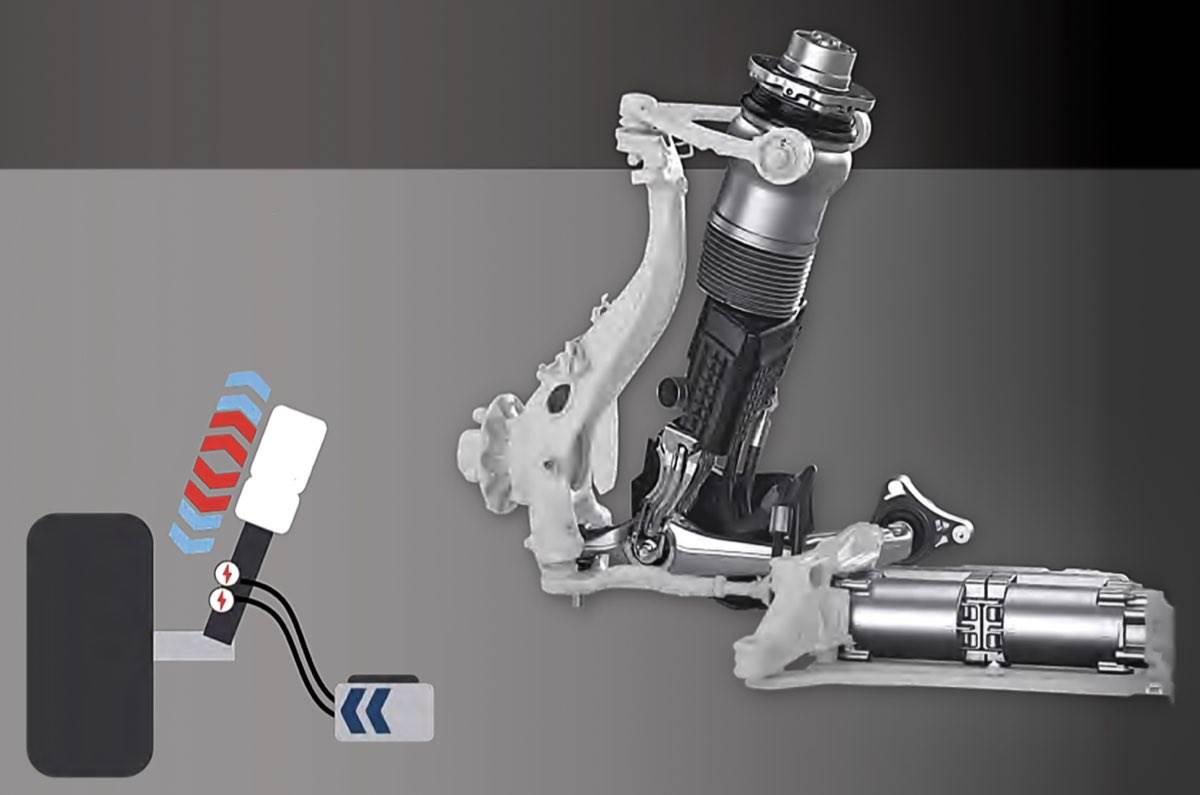
Porsche Active Ride system. (
) Hydraulic system operating at 800V, 10-13 Hz, 2000 pounds, 2inch/sec (I think).

https://newsroom.porsche.com/.imagi...ort/b-technik2.jpg/jcr:content/b-technik2.jpg


System is a 4x bidirectional hydraulic pumps with 400-800v 1800 watt BLDC motor attached to each actuator. Look at the speed that the body responds to the phone, and compare it to the next two systems.

BYD U9 now things get interesting. This is basically a modernized version of the BOSE system, that was sold to ClearMotion. https://www.youtube.com/watch?v=MGCz4Tdr90U&t=76s Notice how much crisper and fast the movements are in response to the phone tilt. Also....the bunny hop is just nuts. Apparently this is a 4.5 KW nominal, 9kw peak bldc motor attached to a hydraulic pump, i assume its 800V, but i can not confirm that. It operates at 100 Hz and 500 mm/sec (19.6 inch/sec) This car just took the EV production car record Nuremburg lap time.

Finally, Nio ET9 another Chinese car, this one is using the clearmotion suspension. https://www.youtube.com/watch?v=SBXglXufprw see how fast the car can rock. https://www.youtube.com/watch?v=G8Ih9ALYo_Y showing the response of the suspension system. This is a 1000 Hz system, but only a 2 inch/sec system. I could not find the power output.


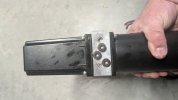
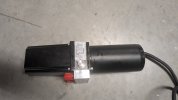
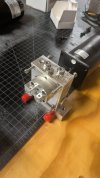
I designed my system in anticipation that I could not source or make a actuator that could do >10 inch/sec., so I am using traditional dampening and springs. If anyone know of small hydraulic pumps or actuators that might work, Im all ears. As is, my active system will be more like Williams/Porsche body control systems. With that in mind, I went out and started buying small hydraulic pumps.

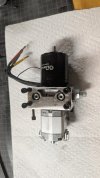
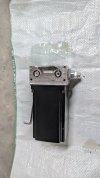
First one: was the HS10-350 its about 1.1L/min bidirectional output @ 15 mpa. https://www.ebay.com/itm/316076660015. This would get me about 1.4 Inch/sec stock at 24v.

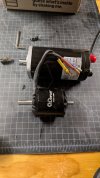
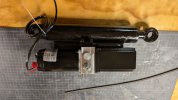
Second one: is part of a 2" bore cylinder https://www.ebay.com/itm/147148211496 1.8L/min, 25 mpa, 12V 800 watt. This would get me 2.5 inch/sec at 12V.

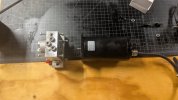
Neither is going to get me to where I need to be stock. So i disassembled them with the goal of swapping to motor to a BLDC motor of much higher power (https://shop.odriverobotics.com/products/odrive-custom-motor-d6374-150kv) 5.3 Kw peak, 2.6 Kw continuous power, 6500 RPM @ 58 volt. I would love to use a 400V motor, but I can find a small 5kw 400v bldc. Again, I'm open to suggestions. The advantage of using a smaller BLDC is i can use the Odrive ESC/controller which allows CAN control @ 8000 Hz, they use these things for drones and balancing robots.

My plan right now is to use the BLDC motor on the larger stripped down hydraulic pack with the 0.65 cc head and run it at 6000 RPM, and that should get me a solid 5 inch/sec extend rate. I may try to source a 1.25 cc bidirectional gear head and see if I can get 10 inch per second, but it going to take more work to source the gear head.

I'm open to any recommendations if anyone out there has hydraulic experience.
 

Attachments

  • PXL_20260302_012008927.MP.jpg
    PXL_20260302_012008927.MP.jpg
    264 KB · Views: 79
  • PXL_20260302_012017657.jpg
    PXL_20260302_012017657.jpg
    271.9 KB · Views: 82
  • PXL_20260302_013712714.MP.jpg
    PXL_20260302_013712714.MP.jpg
    322.2 KB · Views: 75
  • PXL_20260302_013717784.MP.jpg
    PXL_20260302_013717784.MP.jpg
    153.3 KB · Views: 68
  • PXL_20260301_012906149.MP.jpg
    PXL_20260301_012906149.MP.jpg
    322.6 KB · Views: 79
  • PXL_20260301_013325455.MP.jpg
    PXL_20260301_013325455.MP.jpg
    224.4 KB · Views: 78
  • PXL_20260301_013830157.jpg
    PXL_20260301_013830157.jpg
    167.7 KB · Views: 69
  • PXL_20260301_014908291.MP.jpg
    PXL_20260301_014908291.MP.jpg
    192.4 KB · Views: 91
Sourcing/building actuators for the suspension system. When I started designing the suspension system for this car almost 6 years ago now, there were not too many examples of active suspension systems using mechanical actuators.

The over all idea in these systems is that you place a actuator in between the wheel and the body and use it to compensate for forces on the car and/or travel of the wheel. In a ideal form these systems could theoretically replace springs and dampeners, and keep perfect tire contact with the road service. In practice, as with most things, this is very hard to do. Two things have mostly held up the broad adoption of these systems, the first is operating frequency of the system, which generally needs to be greater that 50 Hz (50 times a second). The second is the speed/force of the actuator, which needs to at least be able to push with the force seen on the tire, and ideally 2-3x, more importantly it needs to be able to move fast enough. For body roll control you need 2-4 inch/sec, and for wheel control you need >10-15 inch per second. These are pretty aggressive numbers for most off the shelf hydraulics/electric actuators, where movement rates are more like 0.5-1 inch/second.

In my research I found a few systems that had data I could bench mark off.

The grand daddy of them all, Williams FW14 F1.
This is the system most people know about, but very little details of the system are public. This is really a body roll control system, it was programable to the track it was running on, and adjusted body position for optimal performance on each corner and straight. You can tell looking at the actuators they are really small, with little travel, and just looking at the system in demos, the body does not move that fast. I think I read somewhere that it had ~5 inch/sec of movement @ 10Hz.

The BOSE system.
This system is truly fully active and adaptive. It used electro actuators and computer control to basically do away with springs. vertical movement of the actuator at reported 50 in/sec and operating frequency of 15-50 Hz back in the late 90's and early 00s Lots of information on the system out there and why it never got adapted to racing. It was ok for road cars, but not worth the weight for racing. The core of this system is now being seen in modern Chinese cars like the BYD U9 and the Nino...I will show so videos of its action, very impressive.

The German FSAE team.
and
While not a active system, this team built a fully decoupled body roll system using hydraulics. When you watch the videos of their car, you start to understand the power of these systems, even if we are just addressing body roll.

When you start to think about it, suspension systems on cars are incredibly out of date compared to improvements in almost all other aspects of a vehicle. I think suspension is going to be the next really big differentiator for cars, as HP and torque become pretty much the same for every model. Right now 700 HP is nothing these day, and 0-60's under 3 are the norm. Moreover, in the EV world, most cars a traction limited, HP and torque are available in such excess that speed now really depends on tires and suspension. Gas cars are also converging on this singularity too, but are probably 5 years behind. All that said, I know right now this suspension system seems over kill, just wait in a few years active is going to be the way forward.

I went in to this designing this system without any off the shelf solutions that would get me anywhere near even 5 inch per second, 2000 pounds of force, and 10Hz. I put the smallest diameter hydraulic actuators I could find that would give me the 2000 pounds of force I need (1 inch bore/0.68 stroke), and assumed over time, technology would trickle down, or at the very least I could do a traditional spool based system and try to get the hysteresis down to a point it would all work. Over the last 6 years, a lot has happened in the active suspension space, but nothing off the shelf has trickled down yet. The big systems that came out that have guided my design, are the following.

Porsche Active Ride system. (
) Hydraulic system operating at 800V, 10-13 Hz, 2000 pounds, 2inch/sec (I think).

https://newsroom.porsche.com/.imagi...ort/b-technik2.jpg/jcr:content/b-technik2.jpg


System is a 4x bidirectional hydraulic pumps with 400-800v 1800 watt BLDC motor attached to each actuator. Look at the speed that the body responds to the phone, and compare it to the next two systems.

BYD U9 now things get interesting. This is basically a modernized version of the BOSE system, that was sold to ClearMotion. https://www.youtube.com/watch?v=MGCz4Tdr90U&t=76s Notice how much crisper and fast the movements are in response to the phone tilt. Also....the bunny hop is just nuts. Apparently this is a 4.5 KW nominal, 9kw peak bldc motor attached to a hydraulic pump, i assume its 800V, but i can not confirm that. It operates at 100 Hz and 500 mm/sec (19.6 inch/sec) This car just took the EV production car record Nuremburg lap time.

Finally, Nio ET9 another Chinese car, this one is using the clearmotion suspension. https://www.youtube.com/watch?v=SBXglXufprw see how fast the car can rock. https://www.youtube.com/watch?v=G8Ih9ALYo_Y showing the response of the suspension system. This is a 1000 Hz system, but only a 2 inch/sec system. I could not find the power output.


I designed my system in anticipation that I could not source or make a actuator that could do >10 inch/sec., so I am using traditional dampening and springs. If anyone know of small hydraulic pumps or actuators that might work, Im all ears. As is, my active system will be more like Williams/Porsche body control systems. With that in mind, I went out and started buying small hydraulic pumps.

First one: was the HS10-350 its about 1.1L/min bidirectional output @ 15 mpa. https://www.ebay.com/itm/316076660015. This would get me about 1.4 Inch/sec stock at 24v.

Second one: is part of a 2" bore cylinder https://www.ebay.com/itm/147148211496 1.8L/min, 25 mpa, 12V 800 watt. This would get me 2.5 inch/sec at 12V.

Neither is going to get me to where I need to be stock. So i disassembled them with the goal of swapping to motor to a BLDC motor of much higher power (https://shop.odriverobotics.com/products/odrive-custom-motor-d6374-150kv) 5.3 Kw peak, 2.6 Kw continuous power, 6500 RPM @ 58 volt. I would love to use a 400V motor, but I can find a small 5kw 400v bldc. Again, I'm open to suggestions. The advantage of using a smaller BLDC is i can use the Odrive ESC/controller which allows CAN control @ 8000 Hz, they use these things for drones and balancing robots.

My plan right now is to use the BLDC motor on the larger stripped down hydraulic pack with the 0.65 cc head and run it at 6000 RPM, and that should get me a solid 5 inch/sec extend rate. I may try to source a 1.25 cc bidirectional gear head and see if I can get 10 inch per second, but it going to take more work to source the gear head.

I'm open to any recommendations if anyone out there has hydraulic experience.
At one point back in the late '70s, I seriously considered using a hydraulic suspension system. I had a DC motor- driven hydraulic pump with a Moog servo valve that I thought would do the job. The key was to limit the stroke to as small as possible so as to limit the HP required from the pump and to increase the frequency response of the servo system. I finally realized that this was an infinite time and money pit so I just used a good software package to design a conventional suspension.
 
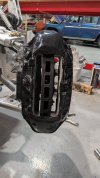
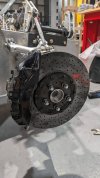
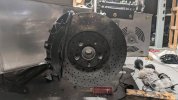
Got the C7 ZR1 carbon ceramic rotors and calipers mounted. Had the wrong size caliper bolts, but everything fits on my custom uprights. Pretty sexy stuff if you ask me.
 

Attachments

  • PXL_20260305_204905156.jpg
    PXL_20260305_204905156.jpg
    356.8 KB · Views: 94
  • PXL_20260305_204854937.jpg
    PXL_20260305_204854937.jpg
    304 KB · Views: 103
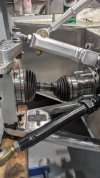
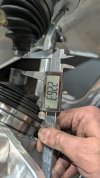
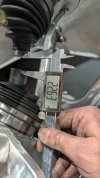
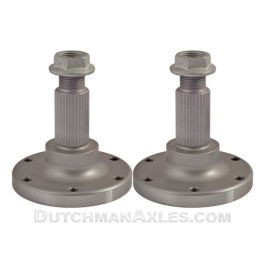
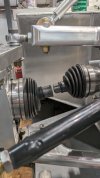
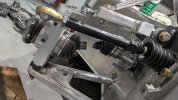
Front axle design. So mounting a front axle to a car never intended to have one is not easy. I settled on using a axle hub from a kia (beefy and narrow) mounted to the side of the chassis directly under the top dampener perch. The 36T drive sprocket will bolt right where the rotor would bolt on a car. Originally, I hoped the I could use two axle ends, one from a C7 Zr1 and one from a Kia, couple them, and call it a day, as they joints have some play, and my calculated movement in the axle from full drop to compression was under 10 mm. Sadly, reality had a different story. Turns out to have just about 1" of travel, so I will have to use a CV joint a one end, and so I might as well just go for Porsche 934 CV's with stub axels at each end, kind of like we do on the rear end. Stubs and CV's will given me more clearance between the hubs, so the angle will not as large too. C7 Zr1 Stub axles are readily available so that is nice, but I am going to have to design one for the Kia, unless anyone knows of a source. I am going to print up a set of stub and 934 CV joints and try to mock up an axle before I order one from The Drive Shaft shop.

But it is coming together. To see a axle on the front end of the car is rewarding knowing how much work it took to get here. To my knowledge this is a first for a SLC, and maybe for any RCR monocoque car.

Also go the caliper bolted, clearance is spot on.
 

Attachments

  • PXL_20260307_213127839.jpg
    PXL_20260307_213127839.jpg
    156.9 KB · Views: 76
  • PXL_20260307_213127839.jpg
    PXL_20260307_213127839.jpg
    156.9 KB · Views: 73
  • PXL_20260307_213214077.MP.jpg
    PXL_20260307_213214077.MP.jpg
    155.5 KB · Views: 74
  • PXL_20260307_213408087.jpg
    PXL_20260307_213408087.jpg
    177.3 KB · Views: 76
  • PXL_20260307_220727611.jpg
    PXL_20260307_220727611.jpg
    190.5 KB · Views: 78
  • PXL_20260307_220734082.jpg
    PXL_20260307_220734082.jpg
    204.1 KB · Views: 75
  • PXL_20260307_213135539.jpg
    PXL_20260307_213135539.jpg
    345.9 KB · Views: 108
So I printed up some 934 CV's and man they are big. I think I might do it all in 930. Ill post some pictures of the the 930 vs 934 setup tonight when I get home. The 930 also has a couple more degree of articulation. I am just going to machine the stubs myself, faster and cheaper.

Bob
 
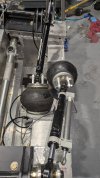
fitted everything yesterday. looks like it all works. 930 cv joints. axle worked out to be 4" spline to spline. Air-ed up the bags for the first time, at they expanded much more than the spec sheet says they should, almost 8 inches! realized i fundamentally didn't understand how these things work, and that they need a constraint/cage to limit deflection and max/min expansion/compression. For my bags its 4.5 inch max/ 2 inch stroke. So working on constraint system now.
 

Attachments

  • PXL_20260314_210736584.jpg
    PXL_20260314_210736584.jpg
    222.8 KB · Views: 73
  • PXL_20260314_163751307.jpg
    PXL_20260314_163751307.jpg
    340.4 KB · Views: 67
  • PXL_20260314_163735376.jpg
    PXL_20260314_163735376.jpg
    408.7 KB · Views: 81
  • PXL_20260314_163706003.jpg
    PXL_20260314_163706003.jpg
    344.3 KB · Views: 88
fitted everything yesterday. looks like it all works. 930 cv joints. axle worked out to be 4" spline to spline. Air-ed up the bags for the first time, at they expanded much more than the spec sheet says they should, almost 8 inches! realized i fundamentally didn't understand how these things work, and that they need a constraint/cage to limit deflection and max/min expansion/compression. For my bags its 4.5 inch max/ 2 inch stroke. So working on constraint system now.
What is the chain drive?
 
The chain drive is for the front electric motors. They are ERAX 228 124 Kw / 220 nM torque one on each side. Chain drive is to transfer power and gear it up 3:1. very hard to make these cars get driven front wheels. I have no idea how someone could do it with a traditional differential and drive shaft. I should say in the final form the chain will be tighter, once i get the metal sprockets made, and will have a chain guard over some of it.
 
Back
Top