Chuck's Jaguar D Type Build

Chuck

Supporter
Bonnet, Brake Ducts

Looking at pictures of original D Types, one can find pictures with no brake ducts, rectangular shaped ducts, and oval shaped ducts. We opted for the later.

A pattern was made. Two holes were cut and joined with a saber saw. The foam edge of the fiberglass panel was sealed with a coat of epoxy.

1742748810037.jpeg


The plan was to place the trim ring and not connect it to the opening on the font of the bonnet, but Ryan was insistent that this detail be done. Here is a picture Ryan took of an original duct which blends into the surroundings making it a detail few will notice.

1742748842749.png


A form was made to confirm the dimensions which was then used as a pattern for cutting the .030 aluminum sections. Each was made in two halves, the bend rolled, then riveted together once the fit was confirmed.

1742748857751.jpeg


To join the tube to the front opening a plenum was needed. A half Styrofoam ball was found at our local Hobby Lobby which was modified to fit. A nipple was added to insert into the opening on the aluminum tube. Fiberglass was applied after wrapping the foam with packing tape. To remove the fiberglass from the form a bit of acetone made the Styrofoam disappear.

1742748875109.jpeg


The inner side trim ring was cut from .050 aluminum using a hole saw and jig saw.

1742748897568.jpeg


The trim ring was drilled for rivets, which are cosmetic. Once the fiberglass panels are painted, the tube and the trim rings will be secured.

1742748911032.jpeg


1742748931669.jpeg


Compare this photo with the original. Too bad few will see it once it is finished. The things we do for our kids!

1742748947485.jpeg

IMG0260
 

Brian Kissel

Staff member
Admin
Lifetime Supporter
Very nice details !! For you, it is what we do WITH our kids. I would have loved to have my father involved. He was a strickler for details. He built RC planes with amazing detail. He would then go crash whatever he just built. He had diabetes real bad and couldn’t see so he had no idea what the plane was doing. But it never stopped him from repairing and building a new one. His glasses had trifocals in the bottom, and bifocals in the top. He would look through the slit in between. Then he wore jewelers glasses on top of them when building. Enjoy the time with your son while he wants to be involved.
My Grandkids could care less one way of the other, and I have some cool stuff. Sorry that they are being left out.

Regards Brian
 

Chuck

Supporter
Very nice details !! For you, it is what we do WITH our kids. I would have loved to have my father involved. He was a strickler for details. He built RC planes with amazing detail. He would then go crash whatever he just built. He had diabetes real bad and couldn’t see so he had no idea what the plane was doing. But it never stopped him from repairing and building a new one. His glasses had trifocals in the bottom, and bifocals in the top. He would look through the slit in between. Then he wore jewelers glasses on top of them when building. Enjoy the time with your son while he wants to be involved.
My Grandkids could care less one way of the other, and I have some cool stuff. Sorry that they are being left out.

Regards Brian
All good points, well taken. I tell folks I am following in Ryan's foot steps since none of these projects would have ever been started without his input. Indeed, I consider myself very fortunate.
 

Chuck

Supporter
Battery Relocation Revisited

Back in February, 2024, relocating the battery under the seat was started. Since then, the seat brackets have been built so this detail can be finished. https://www.gt40s.com/threads/chucks-jaguar-d-type-build.52688/post-592140

The battery box was held in place with counter sunk quarter inch screws after drilling and tapping the tub floor.

IMG_9464.JPG


A concern about the steel cross bar being close to the terminals risking a short circuit was raised, which is a good point. I found rather hefty fiberglass angle bars at McMaster Carr and decided to give it a try. It worked well, eliminating that concern.

IMG_9466.JPG


A 1/16” rubber sheet was added to cover the front of the battery and provide additional protection from inadvertent contact.

IMG_9470.JPG


There is a minimum of two inches clearance from the battery to the bottom of the seat.

IMG_9474.JPG


Now I can call the battery project really done.

The next project will be removing the rear body so that the center section can be separated from the rear section, but first some spring boat, house and airplane projects need to be tackled.
 

Chuck

Supporter
The Great Separation, Part I

After years (literally) of deliberation, the decision was made to separate the rear clip from the center body section. I was reluctant to do so, fearing it would compromise the rigidity of the body. But the challenges reaching the fuel tank and rear suspension, along with the added bit of authenticity, prompted the decision to move forward with the Great Separation.

Critical to the project was assuring that a lip could be created that would fit the rear clip precisely. We came up with a somewhat unorthodox plan.

The location of the tub’s rear panel was marked on the body. Behind the seats, the cut seam is forward of the rear tub panel. This meant that the lip would have to be wider than typical. Three inches was decided upon as an appropriate width so the lip would extend about an inch aft of the rear panel.

1750627540126.jpeg


Fiberglass will be used to create the lip. The next challenge was coming up with a means of keeping the rear clip and the center section perfectly aligned to assure that the fiberglass would produce a lip with a good fit. We decided that the fiberglass needed to be applied before the final separation occurred.

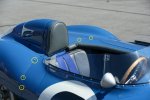
The plan was to cut most of the seam between the two halves but leave one-inch sections in place to hold it together while the fiberglass was applied. One-sixteenth-inch holes were drilled at approximately six-inch intervals to mark the cut line so that it would be visible on the back side. The holes marked with a silver Sharpie are visible in the foregoing picture.

With the body flipped over, the drill holes were connected, marking the location of the cut line on the back side. A second line was drawn three inches aft, defining the limit of the fiberglass lip.

1750627583957.jpeg


Once these parameters were defined, the surface where the fiberglass was to be placed was sanded with 80-grit paper until our marks began to disappear to assure a good fiberglass bond.

At this point, the body was flipped upright. One-inch widths of masking tape were placed next to each of the guide holes. The tape defined the locations where the seam would NOT be cut.

A multi-tool was used to cut along the seam between the sections of tape. It worked surprisingly well, producing a thin, straight cut.

1750627649237.jpeg


The one-inch uncut sections will keep the front and rear aligned as the fiberglass is applied. Later, those one-inch sections will be cut with the Multi-tool. This will create a thin cut in the fiberglass lip, but that can be easily remedied. I sure hope this plan works.
 

Doug M

Supporter
Territory that I’m too scared to venture into, but I have full confidence in your build skills and I’m looking forward to seeing your process.

I have the same concerns in regard to maintenance, but so far I think I have devised a way to make a lot of the rear end accessible via removing the rear wheels and having the inner fender panels attached with Rivnuts or bolts for reasonably easier removal. Also, the updated fuel tank supports can be unbolted and lowered in a worse case scenario.
 

Chuck

Supporter
Territory that I’m too scared to venture into, but I have full confidence in your build skills and I’m looking forward to seeing your process.

I have the same concerns in regard to maintenance, but so far I think I have devised a way to make a lot of the rear end accessible via removing the rear wheels and having the inner fender panels attached with Rivnuts or bolts for reasonably easier removal. Also, the updated fuel tank supports can be unbolted and lowered in a worse case scenario.
Good point. If someone did a cost / benefit analysis this project would get cut from the list. Your approach will provide access to virtually everything one would ever need to access. Indeed, getting into the project, it is apparent that some additional bracing will be needed to make up for the rigidity lost when the rear clip is separated.

But I am having fun with this project, and after all it is a hobby, so we will see how it ends up. Hope to post some more progress updates shortly.
 

Doug M

Supporter
But I am having fun with this project, and after all it is a hobby, so we will see how it ends up. Hope to post some more progress updates shortly.
Fun is the name of the game. And I would imagine that if it ultimately proves too impractical to have the boot/butt of the car on a hinge type setup like the original, it can be mounted on a sub-frame so it can just be detached and removed completely should the need arise.
 

Chuck

Supporter
Fun is the name of the game. And I would imagine that if it ultimately proves too impractical to have the boot/butt of the car on a hinge type setup like the original, it can be mounted on a sub-frame so it can just be detached and removed completely should the need arise.
You raise a good point. I have never seen an original D with the rear clip opened up as if hinged. I am fairly certain that it was designed to be removable, not opened up on a "hinge". Most had their exhaust under the body and the exhaust system would have to be removed to afford clearance when opened on the "hinge." Add to that the rubber fuel cells and the fuel filler complicating a hinged arrangement.

Regardless, my plan is to make the rear clip easily removable by loosening two nuts inside the 'trunk' and a quarter turn of the fasteners on the leading edge. It will also be possible to open as if hinged, but that is not the primary goal. Whether this all works out as planned remains to be seen.

If anyone has seen a picture of an original with the rear clip opened up as if hinged I would love to see it.
 

Chuck

Supporter
No apology needed! Yes indeed, those are the rear supports for the clip. Those two joints carry much of the weight.

Thanks for adding those links. Some very good pics for future reference.
 

Chuck

Supporter
The Great Separation, Part II

The next part of the project was wiping down the surfaces where fiberglass would be applied and then taping off the aft section to prevent the fiberglass from adhering. Shiny packing tape was carefully inserted into each of the cuts, wrapping it both top and bottom, since the fiberglass resin could seep into the cut line.

1751151417733.jpeg


The body was flipped over, and both packing tape and duct tape were applied on the underside aft of the cut line to prevent the fiberglass from adhering.

1751151444448.jpeg


The fiberglass will be applied up to the black line marked on the duct tape, three inches aft of the cut line. Once the tape was smoothed as well as possible, it was waxed to ensure the fiberglass lip would release.

Next, we set up to install the fiberglass, a project which will be tackled later.

1751151475869.jpeg
 

Doug M

Supporter
Chuck, it might be the Mandela effect, but I haven’t really seen a picture of the back section on a hinge, either, though I feel like I have. My thoughts are that it all has to rest on something, so I could see the rear section tipping back and then lifting up for complete removal.

Update as I’m writing this… I did some more digging in my research books and online. I found an Instagram account of the restoration of XKD 522. There are some internal details shown about the rear end, including these pictures that show a hinge setup, but I’m fairly certain I’m correct that its supposed to be unbolted from the mid section, then tipped back and removed.

IMG_7325.jpeg
IMG_7324.jpeg
IMG_7323.jpeg
IMG_7321.jpeg
 

Chuck

Supporter
Very interesting picture. It actually confirms it was not intended to be opened on "hinges" but rather removed.

Missing in the picture is the rest of the underbody brace. There is another section that extends aft from the brace shown in that photo, visible in the picture posted by Pedro. We have been assuming that the clip was supported only by the aft connection points on that underbody brace. The picture you posted reveals it was supported not only by the aft connection point, but also by a connection forward of the trunk, near the rear tires. With four connection points to the underbody frame it would be impossible to open it as if hinged at the rear.

Removal of the rear clip would require disconnecting the four bolts securing it to the under body frame, removing the wide head screws around the leading edge of the body, removing the under body connections to the exhaust, and removing the screws holding the body to the drip pan around the fuel filler. It could then be lifted off.

The rear clip was clearly designed to be removed, but doing so would have been a big job.

I have seen pictures of the rear clip sitting by itself, but non with it in a "hinged" open position.

Those are good pics I had not seen before. Thanks for posting.
 

Chuck

Supporter
The Great Separation, Part III

Next, the fiberglass was laid. To start, between two and three layers of fiberglass were applied, extending three inches forward and two or more inches aft of the cut line. Peel ply, the green material, was used on the West System epoxy to provide a better finish for applying additional layers of fiberglass.

1751833131424.jpeg


Once dry, the one-inch tabs holding the sections together were cut with the Multi-tool using a 1” plunging blade.

1751833153344.jpeg


With the tabs cut, the two sections came apart surprisingly easily.

1751833173946.jpeg


The lip was reinforced with three more layers, bringing the total to five layers of fiberglass. This additional glass also filled in the cuts from the tabs. This should equal or exceed the strength of a comparable thickness of aluminum.

The two halves were set in place for a preliminary check of alignment. The gap is even and is the width of the original seam line. Given fiberglass’s expansion properties, the final gap will likely be enlarged to 3/32”.

1751833206086.jpeg


There is much more to do, but I think this will work. The primary benefit of this approach is that the supporting lip is precisely the same shape as the inner surface of the clip, ensuring a perfect fit.

Now the aft supports need to be revised.
 

Chuck

Supporter
The Great Separation, Part IV

The rear clip is supported at the rear by the underbody frame, which was constructed a long time ago. The fasteners around the leading edge carry minimal weight. So, we turned our attention to the rear end.

The vertical supports for the rear tubes had to be relocated to clear the bottom edge of the rear clip. After using a mill to cut slots in the tubes, tabs were fabricated and then tack-welded in place.

The supports previously made had heim joints on both ends. These were modified so that a tab would join the lower end, matching the other connections visible on this underbody frame. Retaining the heim on the top end will preserve adjustability. For now, the connection is only tack-welded, with final welding and painting deferred until we confirm this setup will work.

1752619535693.jpeg


The rear clip is a bit more ‘flexible’ than before the separation. Accordingly, a composite panel was made using ¼” foam and fiberglass following the same technique used on the bonnet. This significantly added to its rigidity and will serve as the forward wall of the trunk.

The fiberglass on the rear clip is relatively thin, and panels can eventually show a shadow line on the topside painted surface where they are connected. Accordingly, two layers of fiberglass were added to the underside of the clip where the composite panel is attached. Hopefully, reinforcing the fiberglass along the connection line will minimize shadowing of the panel over time.

1752619590543.jpeg


Once the fuel filler cap is in place, any work requiring access to what is under the rear clip will necessitate its complete removal, as on the original. Until then, however, we can open it as if hinged.

1752619625622.jpeg


Next, we will design a fuel filler system, modify the headrest, and install the trunk door.
 
Great solutions as usual. When adding fiberglass to your existing panels, how are you roughing it up to ensure the best bond possible? Do you feel like you need to match the existing resin? I'm assuming original resin is vinylester, but could be polyester I suppose.
 
Back
Top