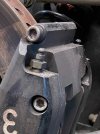
SPF brake firmness

Those caps have the hole in the top. If the inner rubber gaskets are not solid across the inside of the cap, the hole allows fluid to spurt out hence creating issue. These caps were used on many British cars and hence the source of many issues. New caps with solid rubber seals inside would solve this problem. I do not believe the caps are bottoming out on the panel.
Not sure I completely understand "if the inner rubber gaskets are not solid across the inside of the cap". Please elucidate!

No evidence of spurting on top of the caps. Washer inside does not appear fully seated on one.

New caps and washers have been ordered. I will adapt one to use the pressure bleeder...if possible.

Leaving the area for a while though, so this will be a June project.
 
Pegasus has both caps and gaskets.
Hole is necessary for pressure equalization.
I'll guess your original gasket deformed hence symmetrical damage all around cap.
How is the reservoir mounted on the early cars. Perhaps a few photos if possible? I'll document this in the SUPERFORMANCE GT40 Owners Manual or perhaps the Addendum Document. You get your name on the document
Blas
 

Lee Patterson

Supporter
Here's the seal you need from Moss Motors. Click on the PDF they have which expands on the issue and how their seal works.


OBTW, the Wilwood reservoirs do not have a hole in the cap. They must vent inside the cap within the rubber seal.

 
Dang, I had already ordered the caps from Moss...wonder if I can add these gaskets before shipping.

The answer is "no, too late". Looks like another order from Moss as this newer seal looks like it will help solving the issue. Thanks Lee.

Blas, if I end up taking the cover off, then I will take and post photos. There is a good chance once I get into it.
 
Last edited:

Mark H.

Supporter
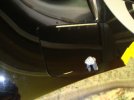
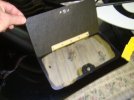
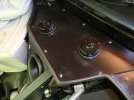
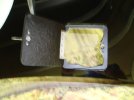
I moved the reserviors from the front A/C cover to the cowl. Made doors in the front clam for access. Was a bit nervous cutting without having to repaint. Raised the reservoirs some and used thin orings to the seal reservior can to cowl sheet metal plate.
 

Attachments

  • DSC00693.JPG
    DSC00693.JPG
    70.2 KB · Views: 56
  • DSC00694.JPG
    DSC00694.JPG
    83.7 KB · Views: 44
  • DSC00697.JPG
    DSC00697.JPG
    94.8 KB · Views: 50
  • DSC00696.JPG
    DSC00696.JPG
    78.8 KB · Views: 57
Quick update - need some advise....I tried bleeding the brakes and I really don't get much fluid out of the rear calipers. I did get some fluid out of the fronts, but less than I was expecting. The brakes have a bit more play in them, but not by much.

I don't know the brake system design on the early SPFs. Is there something between the Master cylinder and the rear brakes like a proportioning valve or a tee fitting? I see what appear to be two lines attaching through couplers near the front left side of the engine. Where the lines route from there I do not know.

Any tips out there?

Thanks,
Mike
 
Quick update - need some advise....I tried bleeding the brakes and I really don't get much fluid out of the rear calipers. I did get some fluid out of the fronts, but less than I was expecting. The brakes have a bit more play in them, but not by much.

I don't know the brake system design on the early SPFs. Is there something between the Master cylinder and the rear brakes like a proportioning valve or a tee fitting? I see what appear to be two lines attaching through couplers near the front left side of the engine. Where the lines route from there I do not know.

Any tips out there?

Thanks,
Mike
There isn't a proportioning valve. The coupler in the engine bay splits to LR and RR. RR does have a brake light switch, but that shouldn't cause your problem. Are you using your pressure bleeder or just manually pumping the pedal? Considering age of your car you may have to replace caliper seals. 20 years is a long time for them.
 

Lee Patterson

Supporter
Mike - My car which is brand new has two hard lines that run from the pedal box (rear brakes and clutch) back along side the driver (mine is RHD). They run through the firewall and then diverge left and right. The clutch runs left across the car and then back (through the motor mount pedestal) to a spot near the back of the tub. The rear brake line runs right along the tub (through the motor mount) and then T's. A hard line goes to the right rear from there as does another hard line that runs across the back of the lower tub to the left rear.

Mine has no prop. valve. Bleed the top outer bleed screw first, then the inner upper. No need to bleed the bottoms.

As I recall, when I commissioned my system, I ran nearly a pint through each caliper. I again was using a MityVac.
 

Lee Patterson

Supporter
OBTW, the pedal on my car is pretty firm. But that would be the way you would expect. There is not a bunch of motion when depressing the pedal. The question would be once you flush the system, how do they stop?
 
Thanks for the replies!

I am getting about 1" of pedal travel now...is this normal? I don't recall.

I am using manual pedal pressure. I did create a pressure bleeder adapter using an old reservoir cap and was able to get about 8-10 psi for a minute or two, but I wasn't getting much fluid out, so I switched to using the pedal. I am still not getting much fluid out.

I see only the top caliper bleed screw...not an inner and outer. I am back at it tomorrow, so I will keep looking and trying.
 

Lee Patterson

Supporter
1" sounds about like mine. It is definitely not "inches" of travel. And very firm when you bind down on it hard.

The current Wildwood caliper has 4 bleeders on it - 2 top and 2 bottom. Yours being very old must have an older style caliper.

Is the reservoir level dropping or not as you pump? are the bleeders fully open.
 
Thanks for the replies!

I am getting about 1" of pedal travel now...is this normal? I don't recall.

I am using manual pedal pressure. I did create a pressure bleeder adapter using an old reservoir cap and was able to get about 8-10 psi for a minute or two, but I wasn't getting much fluid out, so I switched to using the pedal. I am still not getting much fluid out.

I see only the top caliper bleed screw...not an inner and outer. I am back at it tomorrow, so I will keep looking and trying.
I may not be clear what the problem is. I use a pressure bleeder on my old SPF. The surface on the reservoir cap opening is a little questionable but with tightening it will get 20 lbs with no problem. (Approximate measurements) The 3/8 nut has to stay tight. The 1/8 nipple is the bleed. Use that little thing to bleed the brakes. The close nipple is the outer, the tip of the other nipple is the inner ( do that second).
 

Attachments

  • IMG_7409.jpeg
    IMG_7409.jpeg
    198.2 KB · Views: 4

Bill Kearley

Supporter
One of your first statements said the breaks where stiff, Was the engine running and you had vacuum assist ?
I haven't read the entire thread but. The cap can not bottom out. It must seal the diaphragm ( It must not have any holes in it ) DOT 3 or 4 is hydroscopic and water could be your problem. Did the peddle/master cyl return after you depressed it ?
 
Brakes are stiff. The fluid is old. I need to flush the fluid. Engine is not running. I do not think my car (one of the very early SPFs built) is equipped with vacuum assist. I am only getting about an inch of travel and not much fluid is coming out - especially at the rears.

If you read the earlier part of the thread you will see the issue(s) with the caps and the reservoir location on these early cars.

I have more time tomorrow to work through it ... again.
 
Back
Top